
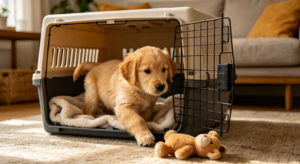
How to Structure Your Puppy’s Day for Crate Training Success
Bringing home a new puppy is exciting, but the first few weeks often come with accidents, chewed shoes, and a lot of guesswork. A crate training puppy schedule takes the guesswork out of those early days. When potty breaks, meals, naps, and play happen at predictable times, your puppy learns what to expect, and good habits start to form on their own.
This guide breaks down a full day of crate training, from wake-up to bedtime, so you can build a routine that fits your household and sets your puppy up for calm, confident behavior.
Key Takeaways
- A consistent puppy schedule pairs crate time with potty breaks, meals, naps, and play in a predictable order.
- Crate time should never be used as punishment. It should feel like a safe, quiet space.
- How long a puppy can stay in the crate depends on age, not convenience.
- A sample daily routine can be adjusted to fit work hours, school schedules, and family life.
- Watching for signs of restlessness helps you catch potty needs before accidents happen.
- Professional puppy training can help when a puppy is struggling to settle or house-train despite a consistent routine.
Why a Crate Training Schedule Helps Puppies
Puppies thrive on structure. A predictable puppy routine helps a young dog understand when it is time to rest, when it is time to go outside, and when it is time to play. Without that structure, puppies are more likely to have accidents indoors, struggle to settle, or get into destructive habits like chewing.
Crate training supports potty training in a very direct way. Puppies naturally avoid soiling the space where they sleep, so a properly sized crate encourages a puppy to hold their bladder until they are taken outside. Over time, this supports consistent potty habits while your puppy’s bladder control continues to develop with age.
A crate training schedule also supports supervision. When a puppy cannot be watched closely, whether you are cooking dinner, on a work call, or simply need a break, the crate gives them a calm, contained space instead of free access to a home they have not yet learned to navigate safely. This reduces the chances of chewed furniture, ingested objects, or reinforced bad behavior.
Just as important, a routine builds calm behavior and impulse control. Puppies who learn to settle in the crate at certain times of day are often better at settling in general, whether that is waiting for a meal, staying calm when guests arrive, or relaxing while the household is active around them.
Crate Training a Puppy Schedule by Time of Day
Every household is different, but the structure below gives you a starting point. Adjust the exact times to match your wake-up hour, work schedule, and your puppy’s age. The pattern to keep in mind is simple: potty break, activity, rest.
Morning
- Wake up and potty break. Take your puppy outside the moment they wake up, before anything else. After several hours in the crate, most puppies will need a potty break right away.
- Breakfast. Feed on a consistent schedule so potty needs stay predictable too.
- Short training session. A five- to ten-minute session on basic cues or name recognition burns mental energy and reinforces good habits early in the day.
- Supervised play. Let your puppy move, explore, and play under your direct supervision.
- Crate nap. After breakfast and activity, most puppies are ready to rest. This is a natural, low-stress time to return to the crate.
Midday
- Midday potty break. Take your puppy out as soon as they wake from their nap.
- Lunch, if age-appropriate. Very young puppies often need a midday meal in addition to breakfast and dinner.
- Afternoon training and play. Another short session paired with supervised playtime helps maintain structure through the middle of the day.
Afternoon and Evening
- Evening routine. Dinner, a potty break, and a period of family time or gentle play help your puppy wind down as the day slows.
- Final potty break. Take your puppy out one last time shortly before bed, after any late evening water has had time to work through their system.
- Bedtime crate routine. Settle your puppy into the crate in a quiet, safe space. A consistent bedtime routine, at the same time each night, helps your puppy learn to settle faster, though very young puppies may still need overnight potty breaks.
This structure works whether you are home all day or managing crate time around work and school. The key is consistency: the same order of events, close to the same times, day after day.
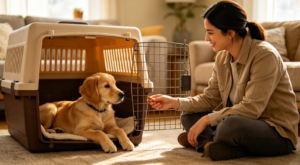
How Long Should a Puppy Stay in the Crate?
Crate time limits depend heavily on age. A puppy’s bladder control develops gradually, and asking a very young puppy to hold it for too long sets them up to fail, not succeed. A commonly used guideline is roughly one hour of crate time for every month of age, sometimes plus one additional hour, up to a reasonable daytime maximum.
This is only a general estimate, since every puppy is different. In practice, that may look like:
8 to 10 weeks old: About 1 to 2 hours at a time
10 to 12 weeks old: About 2 to 3 hours at a time
3 to 4 months old: About 3 hours at a time
5 to 6 months old: Up to 4 hours at a time
As a practical daytime rule, puppies should not be left in the crate for more than 3 to 4 hours at a stretch, especially under 6 months of age. Rest and mental downtime matter as much as bladder capacity, so crate time should still be balanced with potty breaks, activity, and supervised time outside the crate.
Overnight is different from daytime crate time. Once a puppy has an empty bladder and has had a chance to settle, many puppies can sleep for longer stretches overnight than they can during active daytime hours.
Watch your individual puppy rather than relying on the clock alone. Signs a puppy needs a potty break or a break from crate time include:
- Pacing, circling, or scratching at the crate floor
- Whining that is short and urgent rather than ongoing fussing
- Sudden alertness after being settled and quiet
- Sniffing intensely at the corners of the crate
If your puppy shows these signs earlier than expected, take them out. It is far better to offer an early potty break than to let an accident happen in the crate.
How to Make Crate Time Positive
The crate should always feel like a safe space, never a place of punishment. How a puppy feels about the crate has a direct impact on how quickly they settle and how well the schedule works overall.
A few ways to build a positive association:
- Feed meals in or near the crate so your puppy connects it with something they enjoy.
- Use a comfortable, appropriately sized crate. Too large and it may not support potty training. Too small and your puppy cannot stand or turn around comfortably.
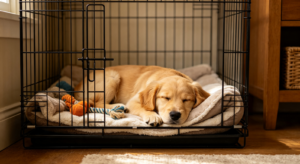
- Add familiar bedding only if your puppy does not chew or soil it, and use a safe puppy-appropriate chew toy to make the space inviting during rest periods.
- Practice short, low-pressure sessions before expecting longer stretches, especially with a brand-new puppy.
- Stay calm during entries and exits. Excited greetings when opening the crate can teach a puppy to associate release with high energy rather than calm behavior.
Consistency matters here too. A crate that is only used occasionally, or only used when a puppy is in trouble, sends mixed signals. A crate used as a regular part of the daily puppy schedule becomes a familiar, comfortable part of their routine.
Common Crate Training Mistakes to Avoid
Even well-intentioned owners can slow down progress with a few common habits:
- Using the crate as punishment. This is one of the fastest ways to create negative associations and resistance to crate time.
- Skipping the potty break before crate time. A puppy who has not had a chance to relieve themselves is far more likely to have an accident.
- Inconsistent scheduling. A crate training schedule only works if it is followed closely enough for the puppy to recognize the pattern.
- Leaving a puppy in the crate too long. Exceeding age-appropriate time limits leads to accidents and increased stress, not better behavior.
- Releasing a puppy while they are barking or whining without checking the cause. If the puppy needs to potty or seems distressed, take them out calmly and keep the break boring. If they are simply protesting, wait for a brief pause before opening the crate so fussing does not become the habit.
- Not providing enough exercise or mental stimulation before crate time. A puppy with pent-up energy will struggle to settle, no matter how good the schedule is.
Avoiding these mistakes keeps the crate training process moving forward and helps the daily routine actually stick.
Puppy Training Tips for Better Daily Habits
A crate training schedule works best as one part of a broader daily structure. A few puppy training tips that support the routine as a whole:
- Keep commands short and consistent. Use the same word for the same action every time, whether it is a cue for going into the crate or for potty breaks.
- Reinforce calm behavior, not just commands. Reward your puppy for settling quietly, not only for completing a specific cue.
- Build in short training sessions throughout the day rather than one long session. Puppies focus better in five- to ten-minute bursts.
- Pair structure with socialization. Supervised exposure to new people, sounds, and environments, alongside your crate schedule, supports well-rounded development.
- Stay patient through setbacks. Occasional accidents or restless nights do not mean the schedule has failed. Puppies need repetition to fully absorb a new routine.
These habits reinforce the same structure and consistency that make a crate training schedule effective in the first place.
When to Get Professional Help
Some puppies need additional support despite a consistent routine. If your puppy has frequent or sudden crate accidents, shows significant or escalating distress, or develops other concerning symptoms, consult your veterinarian to rule out medical or behavioral causes. For puppies that need additional help with crate routines, house training, or everyday training structure, professional puppy training can also provide guidance.
For owners in Ft. Myers, working with a trainer who understands local schedules, households, and lifestyles can make it easier to build a routine that actually fits your day-to-day life, rather than following a generic template.
Final Thoughts
A crate-training puppy schedule doesn’t need to be complicated. It works because it is predictable: potty breaks at the right times, meals on a consistent schedule, naps that follow activity, and a bedtime routine your puppy can count on. Over time, this structure builds the calm behavior, impulse control, and house training habits that make daily life easier for both of you.
Every puppy adjusts at their own pace, so treat this schedule as a flexible framework rather than a strict rulebook. Watch your puppy’s individual signals, stay consistent, and adjust as they grow. If you are working through crate training, potty training, or daily structure with your puppy and want additional guidance, reach out today to speak with a professional trainer in the Ft. Myers area. A little extra help with your schedule and crate habits now can make a lasting difference in your puppy’s behavior later.
FAQs
How long does it take to crate train a puppy?
The time needed to crate train a puppy varies. Some puppies begin settling comfortably within days, while others need several weeks or longer. Consistency, gradual practice, age, previous experiences, and the individual puppy all affect progress.
Should I cover the crate at night?
Covering part of the crate can help create a den-like, calming space for some puppies, as long as airflow is not blocked and the material is safe. Watch how your individual puppy responds, since some settle faster with a cover and others prefer to see their surroundings.
Is it okay to skip crate time on weekends?
It is best to keep the crate training schedule as consistent as possible, even on weekends. Skipping crate time can slow progress and make it harder for your puppy to settle when the routine picks back up.
What if my puppy cries in the crate?
Some fussing during the adjustment period is normal, but first make sure your puppy does not need a potty break and is not showing signs of real distress. If they need to go out, keep the potty break calm and boring, then return them to the crate. If they are simply protesting, wait for a brief pause in the noise before opening the crate, and make sure their schedule includes enough exercise and potty breaks beforehand.
Can I use the crate during the day if I am home?
Yes, daytime crate time is still valuable even if you are home, since it supports rest and prevents your puppy from constant unsupervised access to the house. Following the same schedule of potty breaks, activity, and crate naps helps reinforce consistent habits regardless of whether you are away or nearby.
