
Introduction
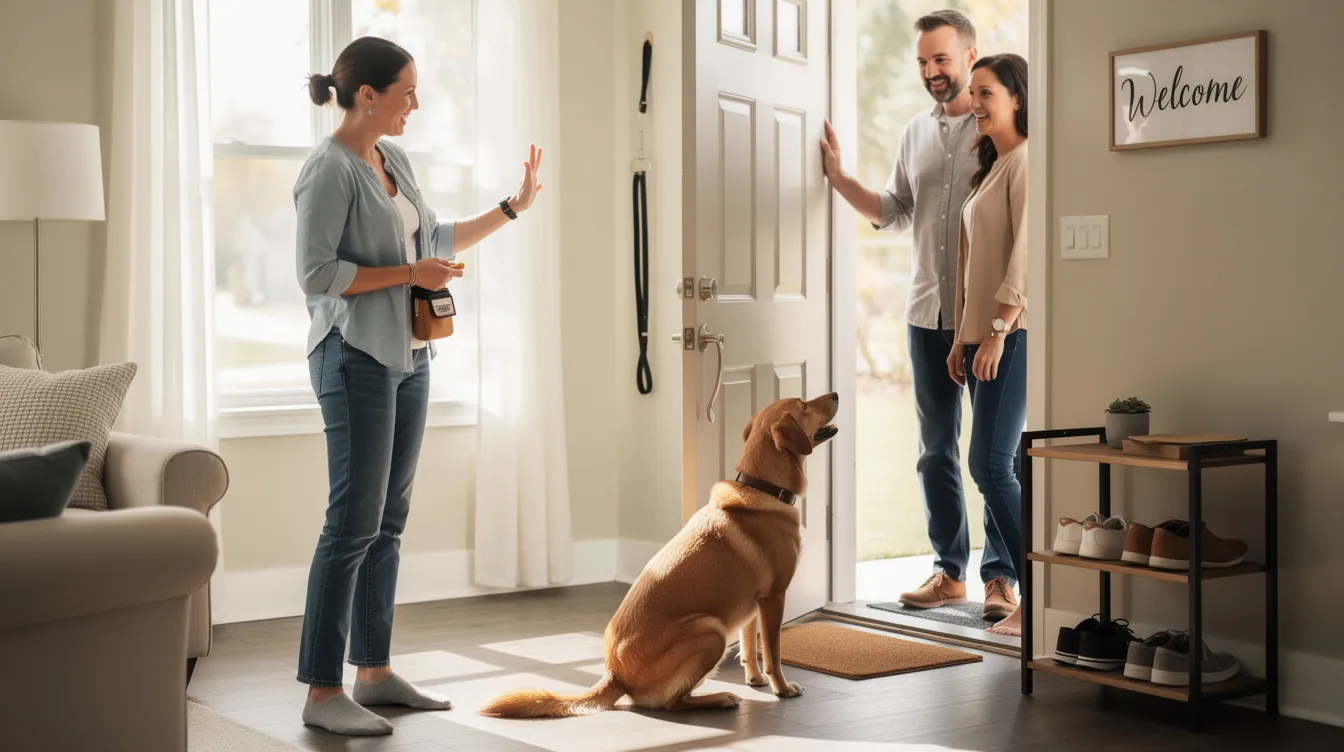
When your dog jumps on every person who walks through the door, it’s more than just an embarrassing habit. A large or excited dog can knock over a child, older adult, or unsteady visitor, while even smaller dogs may scratch people or create an uncomfortable greeting. Teaching calmer greeting behavior can make visits safer and more manageable for everyone in the home.
This guide covers practical ways to stop your dog from jumping on guests, from understanding common reasons behind the behavior to using training, management, and structured greeting routines. Whether you’re dealing with an overexcited puppy or an adult dog with a well-established jumping habit, these strategies can help you build calmer greetings over time. We’ll cover home training techniques, environmental management, guest preparation, and situations where professional training may be useful.
Here’s the direct answer: many dogs can learn to greet people without jumping through consistent training, environmental management such as leashes or baby gates, and reinforcement of an alternative behavior like “sit” or “four on the floor.” Jumping can be a natural greeting behavior, so your dog may need to be taught which greeting behavior you want instead.
By working through this guide, you can work toward:
- Calmer greetings with all four paws on the ground
- Improved guest safety by reducing the risk of knocking people over or scratching them
- More manageable visits when friends, family, and service people arrive
- Better impulse control through consistent obedience practice
- A calmer home routine around doorbells and arriving visitors
Understanding Why Dogs Jump on Guests
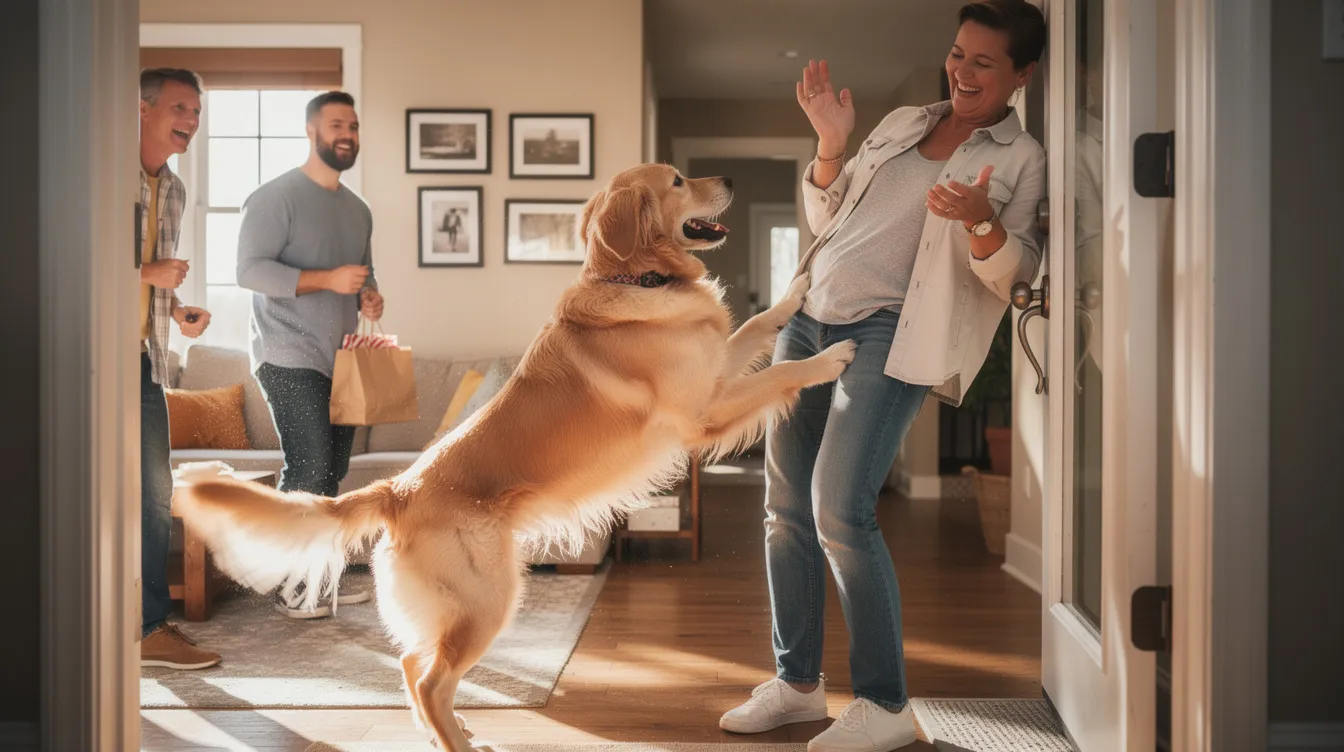
Before you can effectively stop dogs from jumping, it helps to understand what’s driving the behavior. Dogs may jump because of excitement, attention-seeking, learned reinforcement, or difficulty controlling themselves during stimulating situations. Understanding what happens before and after your dog’s jumping can help you choose a more appropriate training strategy.
Attention-Seeking Behavior
Attention is one common reason dogs continue jumping, but it is not the only possible reinforcement. For many dogs, jumping results in eye contact, touching, talking, play, or access to something they want. Because those consequences can make jumping worthwhile from the dog’s perspective, identifying what your individual dog gets from the behavior can help you choose a more effective training strategy.
Research published in Applied Animal Behaviour Science examined factors associated with dogs jumping on people and found that dogs jumped more frequently on household members than on strangers and more often when people entered the home than during walks. These findings show that the person and situation can influence jumping behavior rather than pointing to a single cause.
As PetMD explains, reactions such as pushing a jumping dog away can sometimes provide the interaction the dog was seeking. Instead of focusing only on stopping the unwanted behavior, owners can reinforce the greeting behavior they want to see.
Excitement and Lack of Impulse Control
Excitement can also contribute to jumping, particularly during stimulating moments like a knock at the door or a visitor’s arrival. A dog may respond reliably to a sit command in a quiet room but struggle to maintain the same behavior when someone exciting enters the home.
Puppies often jump because they are excited to interact and because jumping brings them closer to a person’s face and attention. If people consistently respond by petting, talking, playing, or otherwise engaging with the puppy, the behavior can become stronger through repetition. As the dog grows, that practiced greeting pattern may continue unless a different behavior is taught and reinforced.
Age and previous learning can affect how much practice is needed. Puppies are still developing their ability to respond around distractions, while adult dogs may have a longer history of practicing and being reinforced for jumping.
Understanding these factors points toward a practical solution: manage the environment so your dog has fewer opportunities to rehearse jumping, teach a clear alternative behavior, and keep household expectations as consistent as possible.
Preparing Your Home Environment for Success
Knowing why your dog jumps is most useful when you set up the environment to support training. Management can prevent repeated jumping while your dog is learning what to do instead.
Using Physical Barriers and Management Tools
Management techniques can include using a leash, baby gate, crate, or separate room during guest arrivals. These tools can be especially helpful during the initial moments after someone enters, when excitement may be highest.
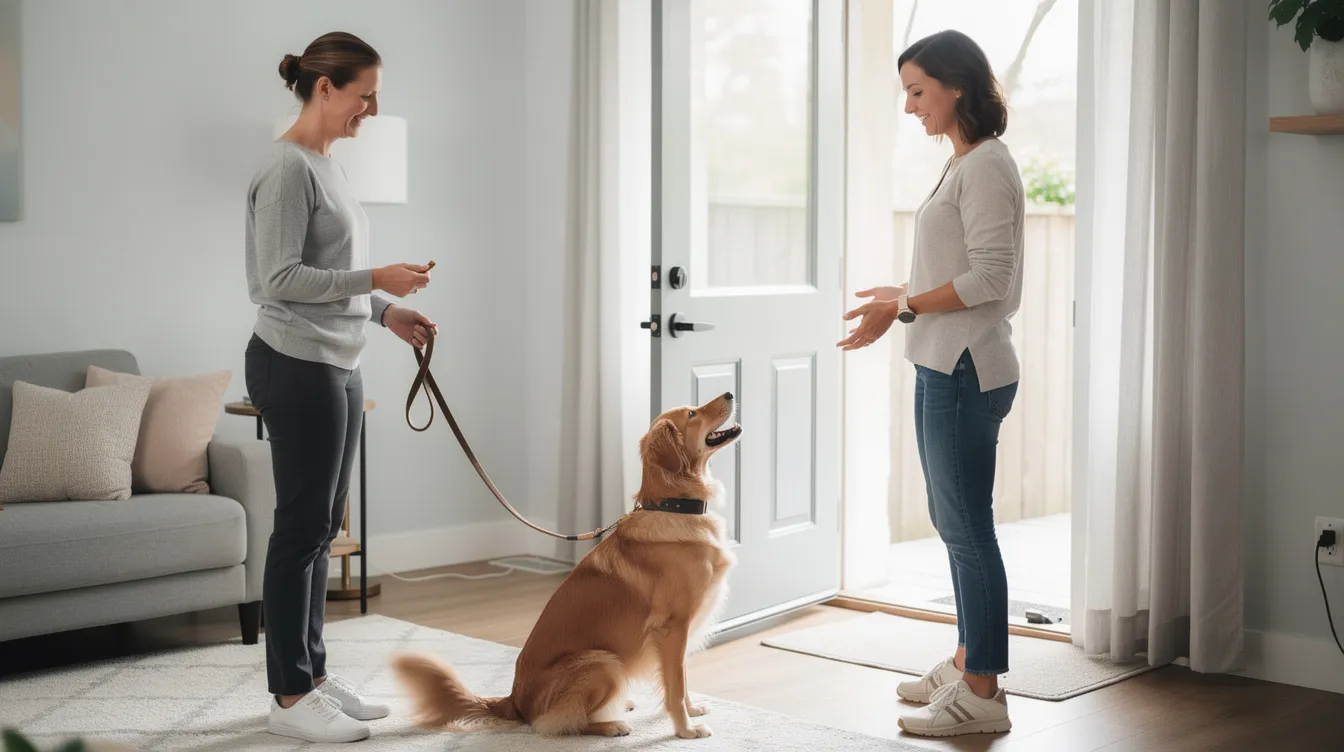
During supervised practice, using a leash can help prevent your dog from rushing toward or jumping on guests while you reinforce a sit, place, or four-on-the-floor greeting. Baby gates or a separate area can provide additional management when needed.
If your dog also growls, snaps, lunges, or shows aggressive behavior toward visitors, prioritize separation and safety rather than practicing close greetings. For more significant behavioral concerns, including reactivity and aggression, dog behavior training programs provide structured behavior modification options.
Food and toys can also help manage greetings for dogs that respond well to them. Scattering treats on the floor before your dog jumps can encourage four paws on the ground while directing attention away from the arriving guest. A food toy or lick mat may also occupy some dogs while visitors enter.
Choose management tools that fit your dog’s behavior. If your dog guards food or becomes tense around treats when other pets or people are nearby, use another management strategy.
Setting Up Training Spaces
Designate a specific area in your home as the greeting zone. In homes with open floor plans, screened areas, or wide entryways, this might mean placing a mat or bed away from the front door. The goal is to create enough distance that your dog does not immediately rush toward someone entering.
Start training sessions in a low-distraction area inside your house, away from the doorway. Practice sit, place, or four on the floor in a quiet setting before gradually introducing more realistic greeting situations.
Arranging furniture or using portable barriers can also create a natural buffer between the entry path and your dog’s position.
For homes with sliding glass doors or larger openings, exercise pens or portable barriers may be easier to position than traditional baby gates.
Guest Communication Strategies
Everyone should follow the same greeting rules as consistently as possible. If some people reward jumping while others discourage it, learning can become slower and less predictable. An occasional mistake does not erase previous training, but frequent exceptions can make jumping harder to change.
Before visitors arrive, explain what you’re practicing. You might ask guests to avoid petting or exciting your dog until all four paws are on the floor or the dog is holding the chosen greeting position.
If deliveries, service appointments, or unfamiliar visitors make it difficult to explain your routine every time, consider posting a small sign near the entrance such as: “Dog in training. Please don’t pet until invited.”
For additional practice ideas, see these tips for teaching calm greetings, including using place or sit commands, management tools, and clear expectations when visitors arrive.
With the environment properly managed, you can begin teaching the behavior you want your dog to perform during greetings.
Professional Training Methods That Work
One practical approach to reducing jumping is teaching a clear alternative behavior that is incompatible with jumping. For example, a dog holding a sit or keeping all four paws on the floor cannot jump at the same time.
These behaviors can be practiced gradually around increasingly realistic greeting situations while management prevents repeated jumping.
Step-by-Step Sit Command Training
The sit command can provide a useful foundation for polite greetings. When the behavior is practiced systematically and reinforced consistently, dogs can learn that sitting is one way to gain access to attention from visitors.
The American Veterinary Society of Animal Behavior recommends reward-based methods for teaching skills and addressing unwanted behaviors.
Here’s a step-by-step approach:
- Assess the jumping pattern. Watch when, where, and on whom your dog jumps most. Note what happens immediately before and after the jumping. Attention, petting, play, access to visitors, or other consequences may contribute to the behavior.
- Choose your greeting rule. Decide whether your dog’s greeting behavior will be “sit,” “place,” or simply keeping all four paws on the floor. Pick a clear expectation your household can consistently reinforce.
- Train the alternative in a calm setting. Practice the behavior in a quiet room with few distractions. Reward successful responses with something your dog values, such as food, praise, or play. A clicker or verbal marker can also help identify the exact behavior being rewarded.
- Practice with family first. Have household members simulate an arrival by stepping outside, knocking, and re-entering while you manage your dog and practice the chosen greeting behavior. Controlled practice allows you to repeat the exercise without the pressure of an actual guest visit.
- Introduce controlled guest scenarios. Invite a cooperative friend who understands the training plan. If your dog jumps, the visitor can pause or withdraw attention. Once your dog returns to the expected position, attention and interaction can resume.
- Practice door-related triggers gradually. If the doorbell itself causes excitement, practice at a low level first. Pair the sound with a familiar cue such as sit or place and gradually work toward realistic arrivals without increasing difficulty too quickly.
- Generalize to real situations. Once your dog succeeds with familiar people, practice around different cooperative guests, environments, movements, and levels of distraction. Increase the challenge gradually so your dog can continue succeeding.
- Maintain the behavior. Continue reinforcing good greetings after your dog begins improving. Rewards can become less frequent as reliability increases, but occasional reinforcement and refresher practice can help maintain the behavior.
For dogs that need more structured training, the Fort Myers Board and Train program includes obedience, place, door manners, training around distractions, and greeting manners focused on preventing jumping.
Training Method Comparison
Different approaches may be useful depending on what reinforces your dog’s jumping, your dog’s existing obedience skills, and the environment.
| Criterion | Ignore Method | Redirect Method | Command Method |
| What it involves | Remove attention when the dog jumps and provide attention when all four paws return to the floor | Reinforce an alternative behavior such as sit, place, or four on the floor | Use a known cue such as sit or place with appropriate management and practice around distractions |
| Timeline to see change | Varies depending on the dog, reinforcement history, and consistency | Varies depending on the dog, reinforcement history, and frequency of practice | Varies based on prior training, distraction level, and consistency |
| Difficulty for owner | Requires consistent responses from household members and guests | Requires good timing and preparation | Requires the dog to understand the cue and gradually practice it around distractions |
| Best suited for | Dogs whose jumping is frequently reinforced by social attention | Dogs that respond well to an alternative behavior or another appropriate reward | Dogs already familiar with basic obedience skills |
| Pros | Removes a common reward for attention-seeking jumping | Gives the dog a clear alternative behavior to perform | Provides a clear structure that can be practiced in different situations |
| Cons | Can be difficult when visitors respond inconsistently | Requires planning and appropriate rewards | Reliability must be built gradually around increasingly difficult distractions |
A functional-analysis study examined what maintained jumping behavior in five companion dogs. The researchers found that different dogs could be reinforced by different consequences, including access to tangible items and owner attention. In the subsequent treatment portion of the study, results varied between individual dogs. The findings support evaluating what maintains a dog’s jumping rather than assuming every dog jumps for exactly the same reason.
For many dogs, combining management with a clearly reinforced alternative behavior such as sitting or keeping four paws on the floor is a practical approach. The goal is to make the desired greeting behavior worthwhile while reducing opportunities for jumping to produce attention or other rewards.
If you’re unsure how to structure the training, private dog training in Fort Myers includes individualized coaching for obedience, jumping, door manners, and other household behavior concerns.
Common Training Challenges and Solutions
Even with a good plan, progress is not always perfectly linear. Here are several challenges Fort Myers and Southwest Florida dog owners may encounter during training.
Dog Still Jumps Despite Consistent Training
If your dog still jumps after regular practice, look at the entire training setup rather than assuming there is one cause.
Jumping may still be receiving occasional reinforcement, but your dog may also need more practice, clearer criteria, better management, or slower progression around exciting visitors. Review what happens immediately before and after each jump to identify patterns that may be maintaining the behavior.
Watch for subtle reinforcement. Does a guest laugh, talk to the dog, touch the dog, or begin playing after the dog jumps? If possible, have another household member observe greetings so you can identify responses that may be encouraging the behavior.
If the current exercise is too difficult, reduce the distraction level and return to a situation where your dog can succeed consistently.
Different Reactions to Different Guests
Your dog may hold a reliable sit for family members but struggle when an unfamiliar person arrives. This can happen because dogs do not automatically understand that a behavior learned with one person or in one situation applies everywhere.
Address this through gradual generalization. Once your dog can greet familiar people calmly, practice with cooperative friends who will follow the same rules.
Gradually vary the person’s appearance, voice, movement, and level of enthusiasm without increasing difficulty so quickly that your dog repeatedly fails. Successful repetitions help your dog learn that the same greeting expectation applies to different people and situations.
The American Kennel Club also recommends reinforcing four paws on the floor and gradually practicing appropriate greeting behavior rather than waiting until the dog has already jumped.
Regression After Initial Success
Temporary setbacks can happen when routines, environments, or visitor patterns change. Progress may also become less consistent if rewards are reduced before your dog can reliably perform the behavior around realistic distractions.
When jumping returns, make the exercise easier again, increase management, and reinforce successful greetings before gradually rebuilding difficulty.
Periodic guest-practice sessions can also help maintain the skill. Family members can simulate arrivals even when actual visitors are not expected.
If regression occurs alongside a more significant behavior concern, such as reactivity, anxiety, growling, or aggression, professional dog behavior training may help you assess the triggers and develop an appropriate management and training plan.
These challenges are common, and many dogs can make meaningful improvements with appropriate management, clear training, and consistent practice. Progress will vary depending on the dog’s previous learning, temperament, environment, and the consistency of the people involved.
Conclusion and Next Steps
Stopping your dog from jumping on guests usually involves three elements working together: understanding what contributes to the jumping, managing the environment so the behavior is practiced less often, and teaching a clear alternative greeting behavior.
Here are your immediate action steps:
- Assess your current situation by noting when, where, and on whom your dog jumps most frequently.
- Choose your primary greeting behavior such as sit, place, or four on the floor and reinforce it consistently during practice.
- Set up your environment with appropriate management such as a leash, baby gate, or designated greeting area.
- Practice controlled arrivals using household members before adding unfamiliar guests and greater distractions.
- Communicate the greeting rules to visitors so they know when and how to interact with your dog.
For dog owners who need additional guidance, or whose dog shows anxiety, reactivity, growling, lunging, or aggression alongside jumping, professional training can provide a more individualized plan and help address safety and management concerns.
If you’re in Fort Myers or Southwest Florida, puppy training programs, private dog training, and behavior training provide structured options based on your dog’s age, behavior, and training needs.
With consistent practice, appropriate management, and a training plan matched to the individual dog, many dogs can develop calmer and more manageable greeting habits.
FAQs
Why does my dog jump on guests?
Dogs may jump because of excitement, attention seeking, learned reinforcement, or difficulty controlling themselves around stimulating arrivals. Looking at what happens immediately before and after the jumping can help identify what may be encouraging the behavior.
How can I use my dog’s nose to help stop jumping?
For dogs that respond well to food, placing or scattering treats on the floor before jumping occurs can encourage your dog to keep all four paws down. The goal is to reinforce the position you want rather than simply distracting the dog after jumping has already started.
What is the best way to teach my dog to stop jumping?
A practical approach combines management with teaching an alternative greeting behavior such as sit, place, or four on the floor. Consistency from household members and guests helps your dog understand which behavior earns attention.
How should guests approach my dog during training?
Ask guests to remain calm and avoid rewarding jumping with immediate attention. Once your dog is following the chosen greeting rule, the guest can provide calm attention or petting if your dog is comfortable with the interaction.
Can using a lead help prevent jumping?
Yes. During supervised training, a lead can help prevent your dog from rushing toward guests while you practice a sit, place, or four-on-the-floor greeting. A baby gate or separate area may also be useful when additional management is needed.
How important is it to wait for my dog to calm down before greeting?
Giving your dog time to settle can make greetings easier to manage. Reinforcing calm behaviors before allowing interaction helps establish clearer expectations around visitors.
