
Introduction
Mental enrichment for dogs means deliberately challenging your dog’s brain through problem-solving tasks, sensory experiences, and learning opportunities-activities that go far beyond tossing a ball or handing over a chew toy. When dogs lack adequate mental stimulation, they often develop unwanted behaviors like excessive barking, destructive chewing, and hyperactivity. A structured approach to canine enrichment addresses the root cause: an under-engaged mind.
This guide covers the three core pillars of dog enrichment-cognitive games, sensory stimulation activities, and food-based mental challenges-along with practical implementation strategies tailored for pet parents, including those living in Southwest Florida where heat and humidity shape how and when you can keep your dog active. Whether you have a high energy pup, an anxious rescue, or a senior companion, you’ll find enrichment ideas scaled to your dog’s needs.
Mental enrichment involves purposeful activities that engage a dog’s mind through problem-solving, learning, and sensory experiences-requiring active decision-making rather than passive entertainment. Dogs benefit from engaging in problem-solving activities because these tap into cognitive circuits that physical exercise alone cannot reach.
Here’s what you’ll gain from this guide:
- Improved behavior: Fewer destructive habits, less reactivity, and calmer everyday life
- Reduced anxiety: Lower stress levels and greater emotional resilience
- Stronger training foundation: Better focus, impulse control, and off-leash reliability
- Enhanced bond: Deeper connection between you and your furry friends through shared cognitive work
- Prevention of decline: Cognitive enrichment helps reduce cognitive decline in aging dogs
Understanding Mental Enrichment for Dogs
Mental stimulation is directly linked to a dog’s overall well being and training success. Dogs thrive when their minds stay engaged-not just their bodies. Understanding what enrichment actually means, how it changes behavior, and how it complements physical exercise gives you the foundation to build an effective program.
What Mental Enrichment Means
Mental enrichment is cognitive exercise for dogs: structured activities that require thinking, choosing, and solving rather than simply reacting. Environmental enrichment encompasses purposeful additions to a dog’s routine that satisfy psychological, sensory, social, and cognitive needs-fulfilling species-typical behaviors that domestic dogs still carry from their ancestors.
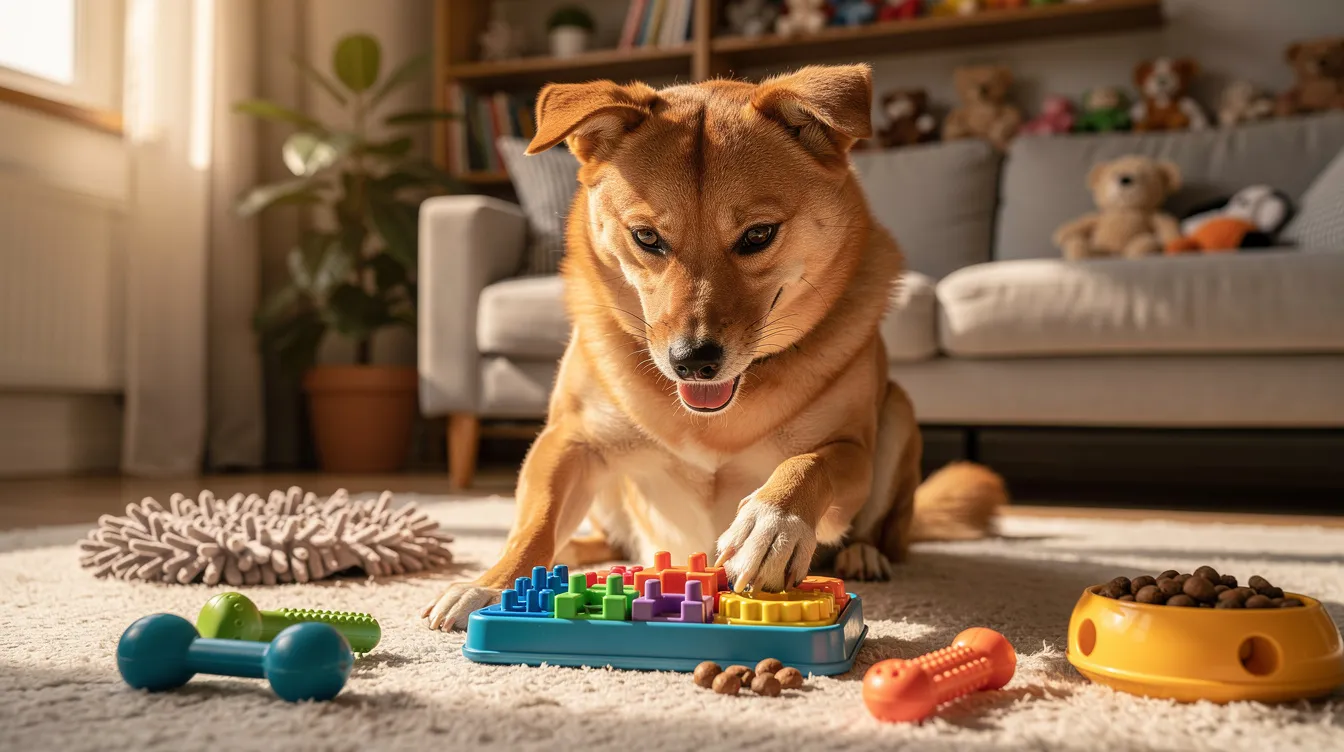
The distinction between enrichment and simple entertainment matters. A rubber mat with kibble scattered on top entertains momentarily. A puzzle feeder with sliding compartments that your dog must manipulate through trial and error-that’s enrichment. True mental challenges involve choice, delayed rewards, variation, and novelty. Puzzle toys challenge your dog to figure out mechanisms. Scent games force discrimination between odors. Trick training demands memory and motor planning.
This connects directly to a dog’s natural instincts. Wolves and ancestral canids spend the majority of their waking hours scent tracking, hunting, and foraging. Domestic dogs retain these drives. Activities mimicking foraging-scatter feeding, snuffle mats, nose work-tap into deeply rooted natural behaviors. Research shows that scent enrichment and exploration reduce stress and increase relaxation, precisely because they satisfy what dogs are wired to do.
How Mental Stimulation Affects Dog Behavior
Mental stimulation uses different brain circuits than physical activity, consuming cognitive energy in ways that running or fetching cannot. A dog may be physically exhausted yet still mentally understimulated, which manifests as hyperactivity, inability to settle, and distractibility. Studies confirm that training and cognitive games reduce stress indicators even when physical activity is limited.
The connection to reduced destructive behaviors is well-documented. In a shelter trial involving 107 dogs, animals given daily food-toy enrichment combined with behavior training significantly reduced jumping, barking, and undesired cage behaviors compared to controls. Enrichment prevents boredom and destructive behavior in dogs by redirecting cognitive energy toward productive problem-solving. For owners struggling with chewing problems, mental enrichment often addresses the underlying cause rather than just the symptom.
The impact on focus during training sessions is equally significant. Dogs with regular cognitive enrichment show better response to commands and less reactivity to distractions. Increasing cognitive load through enrichment generalizes to better impulse control and decision-making in novel situations-precisely what off-leash reliability demands.
Mental vs Physical Exercise Balance
Physical exercise delivers essential benefits-cardiovascular health, joint strength, and physical enrichment helps maintain a healthy weight in dogs. But physical activity alone does not teach decision-making or impulse control. Dogs benefit from physical activities like fetch and agility, yet those activities address only one dimension of canine wellness. Mental work emphasizes attention, focus, and adaptability, engaging regions of the dog’s brain responsible for planning and emotional regulation.
Five minutes of brain work equals thirty minutes of walking. While scientific validation of this exact ratio is limited, the directional truth is well-supported: mentally stimulating activities reduce stress indicators and unwanted behaviors in shorter durations than physical exercise alone. In enrichment pilot studies, 15-minute sessions yielded measurable increases in relaxation and reductions in stress behaviors. Short training sessions can effectively stimulate a dog’s brain, making enrichment accessible even for busy schedules.
The ideal approach combines both. A dog that receives adequate physical stimulation and mental challenges develops balanced behavior, better health, and stronger resilience. Understanding this balance sets the stage for choosing the right activities.
Types of Mental Enrichment Activities
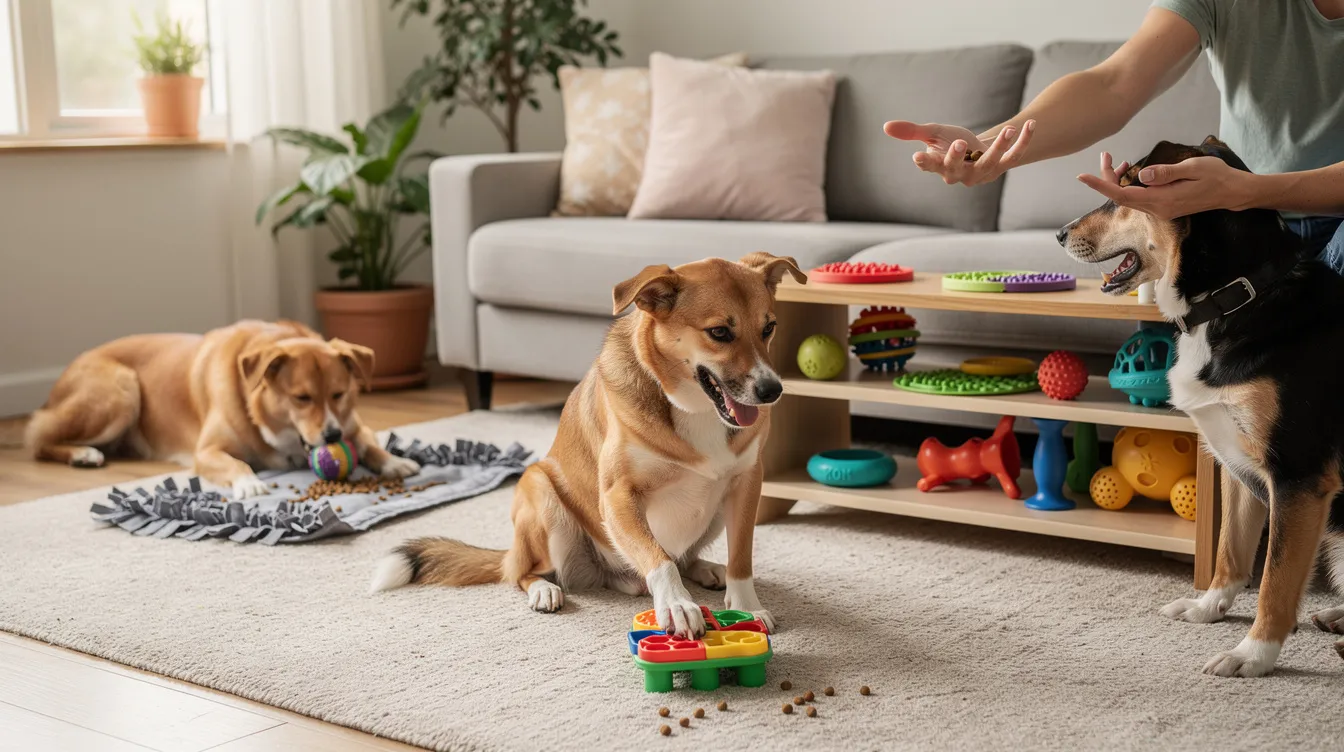
Three main categories of enrichment activities address different aspects of canine intelligence: cognitive games that build a dog’s problem solving skills, sensory activities that engage the full range of perception, and food-based challenges that transform meals into mentally stimulating experiences.
Cognitive Enrichment Games
Puzzle toys and treat-dispensing challenges are the most accessible entry point. These include sliding covers, rotating compartments, and treat dispensing balls that require manipulation to release rewards. The best puzzle toys offer adjustable difficulty so you can scale complexity as your dog learns. Cognitive enrichment encourages problem-solving and skill-building activities, and these toys challenge dogs at every level from beginner to advanced.
Hide and seek games build tracking ability, scent discrimination, recall, and impulse control. You can hide treats inside boxes around a room, conceal favorite toys, or have family members hide themselves while the dog waits for a release cue. This fun game strengthens the bond between dog and handler while engaging natural instincts. Dogs love the combination of searching and discovering, and each session reinforces patience and focus.
Trick training and command sequences engage memory, motor planning, and sustained attention. Teaching new tricks-spin, bow, back up, or weave through legs-provides extra mental stimulation that directly supports obedience work. Trick training is a form of cognitive enrichment for dogs, and professional trainers often use chaining (linking multiple commands) to build complex behavior sequences useful for rally obedience and advanced work.
Memory games and pattern recognition push cognitive boundaries further. Shell games where your dog must track which cup hides the treat, or rotating which bowl contains the reward, test working memory and visual discrimination. In cutting-edge research, a therapy dog learned to use a four-button computerized gaming interface over 66 sessions across 11 months, progressively improving response time and accuracy-demonstrating that dogs learn and improve through sustained cognitive engagement.
Sensory Stimulation Activities
Scent work and nose games provide enormous mental load because a dog’s olfactory system is extraordinarily developed. You can hide treats in boxes, create scent trails through rooms, or set up essential oil identification stations. Scent games encourage natural sniffing behaviors in dogs. In shelter studies, dogs given calming scent enrichment like lavender during stressful events showed reduced stress indicators. Activities involving sniffing and foraging allow dogs to engage in their natural behaviors, and barn hunt training channels this instinct into structured, rewarding work.
Texture exploration lets your dog explore different surfaces and materials-sand, grass, bark, textured mats, rubber mat surfaces, and puzzle pads. Walking on novel textures stimulates tactile nerves in the paws and provides the kind of novelty that keeps a dog’s mind active. For dogs with physical limitations, texture exploration offers enrichment without demanding high mobility.
Sound identification and desensitization involves introducing various ambient sounds-wind, thunder, traffic, doorbells-gradually and positively. This builds a dog’s confidence in new environments and reduces fear responses. Enrichment can include sensory activities like sniff walks combined with exposure to new soundscapes. New walking routes offer dogs different sights, sounds, and smells, making even daily walks a source of enrichment.
Visual tracking and movement-based challenges use moving toys, following targets, or games requiring visual discrimination. Dogs are dichromatic and rely more on movement and contrast than color, so activities involving motion-tracking a toy dragged on a string, following hand signals across distance-engage visual processing effectively.
Food-Based Mental Challenges
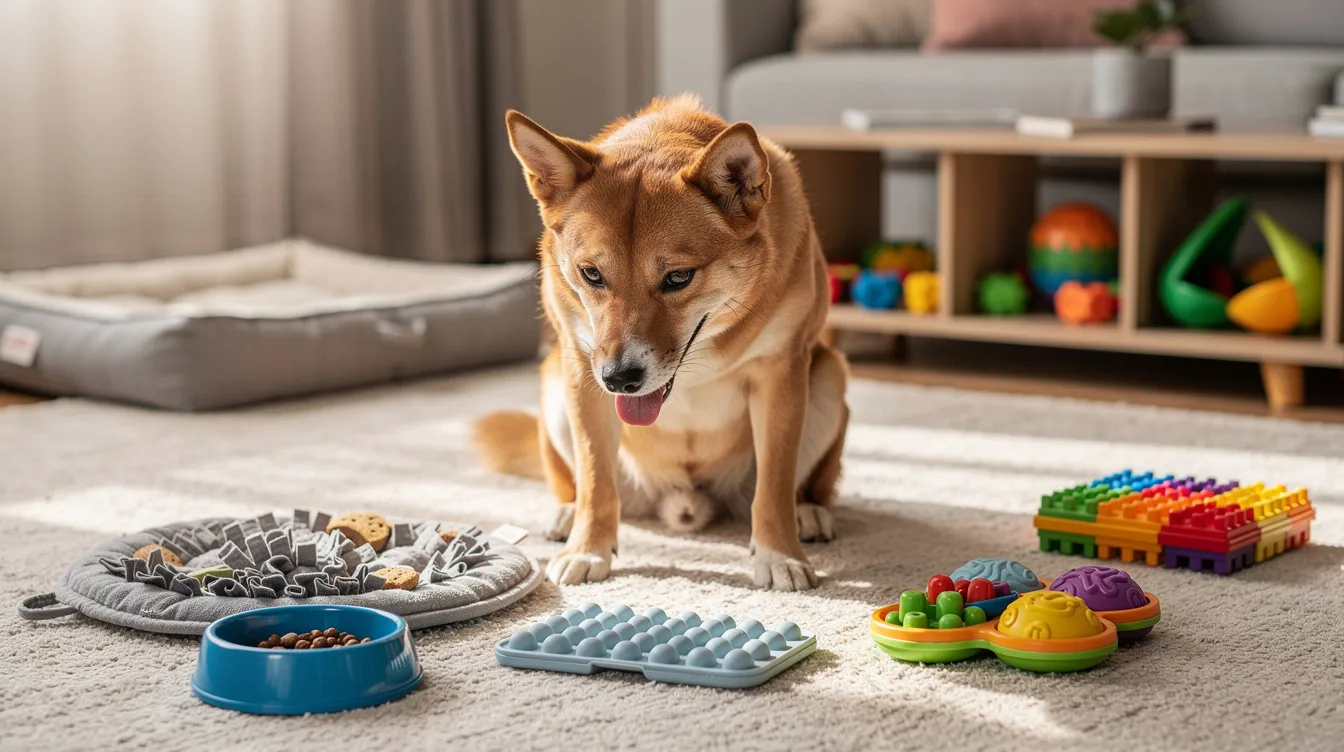
Slow feeder bowls and puzzle feeders transform ordinary mealtime into cognitive work. Puzzle feeders stimulate the brain and slow down eating, improving digestion while providing mental challenge. Snuffle mats encourage dogs to forage and engage their senses during meals. Lick mats spread with wet food provide sustained engagement and calming effects. Food based enrichment turns a routine event into an enrichment activity requiring no extra time from pet parents.
DIY food puzzles using household items make enrichment accessible and affordable. A muffin tin puzzle-place treats in a muffin tin and cover each cup with tennis balls-is a classic example. You can also use a paper bag with treats folded inside, cups arranged for a shell game, or towel roll-ups with kibble. DIY enrichment activities work well for rotating novelty because you can create new configurations with non toxic materials you already own.
Frozen Kong toys with layered treats extend engagement time significantly. Layer peanut butter, kibble, wet food, and tasty treats, then freeze. The multiple stages of reward maintain motivation, and the frozen element adds difficulty and duration. Research on dogs left alone with different enrichment types found that long-lasting chews reduced arousal and increased positive engagement more than treat-dispensing toys or smart devices-making frozen food items especially valuable when owners are away.
Scatter feeding and foraging opportunities involve spreading kibble across a lawn, through foliage, or under rugs. This engages a dog’s most powerful sense-smell-while encouraging physical movement at a natural pace. Hiding food throughout an environment mimics the foraging patterns dogs are built for. For dogs dealing with separation anxiety, scatter feeding before departure redirects attention and reduces stress.
With these enrichment activities established, the next step is organizing them into a systematic daily program.
Implementing Mental Enrichment Programs
Random enrichment helps, but structured approaches multiply the benefits. Creating a consistent routine with appropriate variety and progressive difficulty ensures lasting behavioral change rather than temporary distraction.
Creating a Daily Mental Exercise Routine
Consistent mental enrichment provides maximum behavioral benefits when sessions are planned, tracked, and adjusted over time. Enrichment reduces stress and anxiety in dogs most effectively when it becomes a predictable part of daily life.
- Assess your dog’s current mental stimulation needs: Evaluate breed, age, behavioral signs (hyperactivity, destructiveness, anxiety), and environment. A high energy pup confined to a small yard needs different enrichment than a senior dog in a spacious home. Consider what enrichment already exists in your dog’s everyday life.
- Start with 5-10 minute sessions twice daily: Cognitive work tires dogs quickly, especially anxious or older animals. Short training sessions can effectively stimulate a dog’s brain without causing frustration. Morning and evening sessions work well, particularly in Southwest Florida where midday heat makes outdoor activities impractical.
- Rotate between cognitive, sensory, and food-based activities: A pilot study on assistance dogs found that dogs benefit significantly more from a mixture of enrichment types than from one type repeated. Alternate brain games one session with scent work the next, and food puzzles at mealtime. Rotating toys helps maintain novelty and keeps dogs engaged.
- Gradually increase difficulty as dog masters skills: Once your dog solves a puzzle quickly, add steps, reduce treat value, increase delay, or add distractions. Ensure mastery at each stage to prevent frustration. Enrichment builds confidence and resilience in dogs when difficulty scales appropriately.
- Track behavioral improvements and adjust program: Monitor frequency of unwanted behaviors-barking, chewing, hyperactivity-alongside signs of anxiety, training response quality, and sleep patterns. Set a baseline and compare after one to two weeks. In the shelter trial referenced earlier, dogs showed measurable increases in desirable behaviors like sitting and lying quietly.
For pet parents in Southwest Florida, schedule outdoor scent work and physical challenges during early morning or after sunset to avoid heatstroke. Use air-conditioned spaces for indoor puzzle feeders, interactive games, and training exercises during midday heat.
Choosing Activities by Dog Personality
Many dogs fall into broad temperament categories that guide enrichment selection. The table below maps personality type to appropriate activity approaches:
| Criterion | High Energy Dogs | Anxious Dogs | Senior Dogs |
|---|---|---|---|
| Activity Type | Complex puzzles, vigorous scent work, obstacle course challenges, agility training | Calming scent enrichment, slow feeders, gentle trick training, lick mats | Stationary nose games, puzzle feeders, memory games, gentle scent work |
| Duration | 15-20 minutes per session | 5-10 minutes, building gradually | 5-10 minutes with rest breaks |
| Difficulty Level | High and rapidly progressive | Low, increasing very slowly | Moderate, avoiding frustration |
| Best Times | Morning and evening (especially in SW Florida heat) | When dog is naturally calm | Consistent daily schedule |
| Social Component | Play with other dogs, tug of war, interactive games | Gentle human interaction, supervised exposure | Calm companionship, low-pressure socialization |
Social enrichment includes positive interactions with other dogs, and supervised playgroups enhance social skills in dogs. Social interactions reduce fearfulness and overexcitement in dogs, making group activities valuable for appropriate temperaments. Structured daycare sessions provide social enrichment for dogs who enjoy canine company.
Breed traits also matter: scent hounds excel at tracking work, terriers prefer digging pit activities and fast-paced games, and working breeds need the most cognitively demanding challenges. Dog enrichment can improve behavior and bolster emotional well-being when activities align with breed-specific drives.
Even older dogs respond well to enrichment programs-cognitive enrichment helps reduce cognitive decline in aging dogs by maintaining neural activity and engagement. The key is matching challenge level to current capacity.
Common Challenges and Solutions
Every dog owner implementing mental enrichment programs encounters obstacles. Here are the most common problems with practical, tested solutions.
Dog Loses Interest Quickly
Rotate activities every 3-4 days to maintain novelty across cognitive, sensory, and food-based categories. Even changing scent types or rearranging puzzle configurations can re-engage a bored dog. Increase the difficulty level gradually-if your dog solves puzzle toys immediately, the challenge isn’t sufficient to keep a dog entertained. Combine high-value tasty treats with mental exercises initially to build strong positive associations, then transition to lower-value rewards or praise as engagement becomes self-reinforcing. Dog lovers often find that variety matters more than complexity.
Activities Too Easy or Too Hard
Start at your dog’s current skill level using trial-and-error observation. If your dog shows frustration or gives up, scale back immediately. If boredom signals appear-sniffing away, walking off-increase complexity. Break complex puzzles into smaller sub-tasks: start with one compartment of a multi-compartment puzzle before introducing the full challenge. Adjust treat value strategically: use cheese or meat for difficult new tasks, lower-value kibble for practiced skills. Dogs learn most effectively when success rate stays around 80%, keeping motivation high while still providing genuine mental challenges.
Limited Time for Enrichment
Replace regular feeding with puzzle feeders or scatter feeding-mealtime becomes enrichment with zero extra time investment. A muffin tin with tennis balls over each cup of kibble takes 30 seconds to prepare and provides 10 minutes of engagement. Use daily walks as opportunities for sensory enrichment by allowing extended sniffing and taking novel routes that let your dog explore new environments. Incorporate mental challenges into existing training sessions-adding simple commands or training exercises to daily routines embeds enrichment into everyday life without demanding separate blocks of time.
Enrichment strengthens the bond between dogs and humans, making the investment of even small amounts of time worthwhile for lasting behavioral improvement.
Conclusion and Next Steps
Mental enrichment is not an optional luxury-it’s foundational to raising a balanced, well-behaved dog. Mental stimulation is important for a dog’s overall well-being, and the research is clear: dogs receiving consistent, varied cognitive challenges show fewer behavioral problems, less anxiety, better training outcomes, and stronger bonds with their owners. Enrichment supports physical fitness and healthy weight in dogs while keeping a dog’s mind sharp across every life stage.
Start building your enrichment program today:
- Assess your dog’s current mental stimulation level-note any destructive habits, anxiety signs, or difficulty focusing during training
- Choose 2-3 activities from different categories to begin this week (one cognitive game, one sensory activity, one food puzzle)
- Establish daily 10-minute enrichment sessions, preferably during cooler hours if you’re in Southwest Florida
- Track changes in behavior over two weeks and adjust difficulty and variety accordingly
For dog owners looking to take enrichment further, consider how structured programs like board-and-train integrate daily mental enrichment protocols alongside obedience work, producing dogs that return home already conditioned to enrichment routines. For dogs with specific behavioral challenges like reactivity or excessive barking, professional guidance ensures enrichment targets the right problems with the right intensity. Dog opportunities for growth are limitless when mental and physical enrichment work together.
