
Introduction
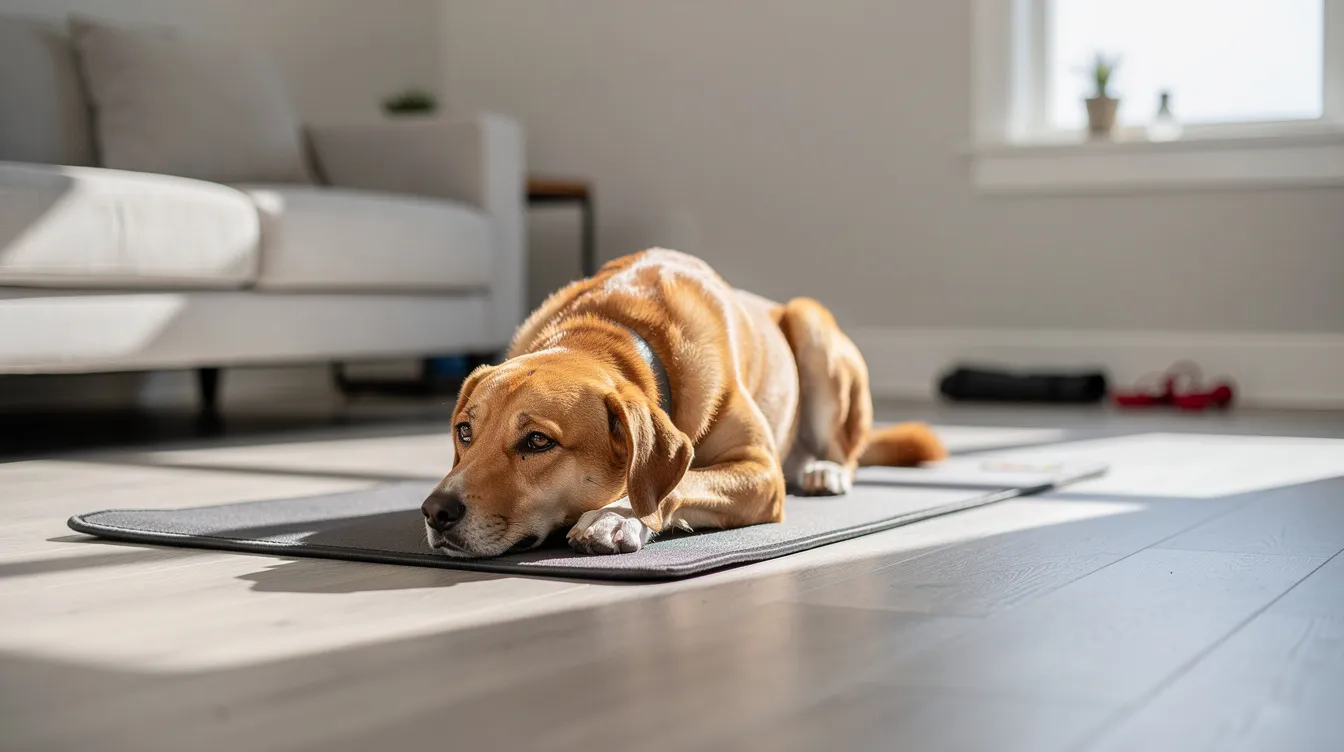
Dog settle on mat training teaches your dog to go to a designated mat or dog bed, lie down calmly, and remain there until you give a release cue. It’s one of the most practical skills in all of dog training – an “off-switch” that transforms chaotic moments into calm ones, whether you’re eating dinner, greeting guests, or sitting in a veterinary waiting room.
This guide covers everything from basic mat introduction through advanced distraction-proofing, targeting dog owners of any experience level who want reliable calm behavior they can take anywhere. We’ll walk through equipment selection, step-by-step training phases, troubleshooting, and how to integrate settle into off-leash obedience. What falls outside scope: severe behavioral disorders requiring veterinary behaviorist intervention, though we’ll touch on how mat work supports behavior modification.
Here’s the direct answer: Dog settle on mat training involves teaching your dog to go to a specific mat or bed and lie down calmly until released, creating a portable “calm space” you can use anywhere – at home, in public, or during stressful situations. Positive reinforcement is effective in teaching mat training for dogs, and most dogs grasp the basics within one to two weeks of daily short sessions.
By the end of this guide, you’ll understand how to:
- Establish a reliable calm behavior on command using a clear cue like “settle”
- Manage excitement during daily activities like meal prep, doorbell rings, and family dinner
- Create a portable relaxation tool that works in any environment
- Build genuine self control and impulse regulation in your dog
- Achieve distraction-proof reliability suitable for off-leash scenarios
Understanding Settle on Mat Behavior
Settle on a mat is a foundational calm behavior where dogs learn to self-regulate on a designated surface. It goes beyond a simple “down-stay” – a true settle means your dog lies down with a relaxed body, lowered head, and minimal restlessness. The mat itself eventually becomes a conditioned safe space that elicits calm even before any reward appears. This makes it invaluable for everyday dog management and structured behavior modification programs.
Core Components of the Behavior
The settle behavior consists of several sequential elements that build on each other:
- Going to the mat on cue from any distance or direction, whether you’re standing next to it or across the room
- Lying down and maintaining relaxed body posture – the dog lies with body lowered, head resting, no paw lifting or alertness signals. Some advanced protocols include chin rests and hip rolls indicating deep relaxation
- Remaining on the mat until given a release command – dogs should remain on the mat until released by the owner, which prevents confusion about when the exercise is finished
- These components connect to the central goal: creating reliable calm behavior that your dog offers willingly, not just mechanical compliance with a position
Benefits for Real-World Applications
A well behaved dog that settles on cue changes daily life dramatically. Managing doorbell reactions and guest greetings becomes straightforward – a mat can serve as a safe space for nervous dogs around guests, and mat training reduces aggressive behaviors toward guests by giving the dog a clear alternative behavior. During meal preparation and family dinner, your dog settles on their mat instead of begging or counter surfing.
Because the mat is portable, you create a calm zone anywhere. Using a mat can reduce a dog’s anxiety during vet visits, and the same behavior translates to outdoor dining, travel, and public spaces. Dogs can be conditioned to retreat to a mat during conflicts, and mat training aids in desensitization to new stimuli – making it a cornerstone tool for dogs dealing with separation anxiety or resource guarding issues.
With these foundations clear, let’s set up the physical environment and tools you’ll need before your first training session.
Setting Up for Success
Before you begin teaching your dog to settle, proper preparation eliminates common frustrations and accelerates learning. The right equipment and environment make the difference between a dog that genuinely relaxes and one that simply tolerates lying down.
Choosing the Right Mat
A distinct, comfortable mat can be used for relaxation training – but not just any surface will do.
Size matters significantly. The mat must accommodate your dog’s full body length and width, allowing them to stretch out, roll onto a hip, and lie down fully without any part hanging off. A cramped mat prevents genuine relaxation. For a Labrador, think at least 36 by 24 inches; for a German Shepherd, go larger.
Material should be durable with a non-slip bottom so the mat doesn’t slide on hardwood or tile when your dog steps onto it. Washability is essential – this mat will see heavy use. Some trainers prefer elevated platform beds or cots for advanced place work, as the raised edge gives dogs a clearer boundary.
Visual distinction helps early learning. Choose a color and texture that contrasts with your floor so your dog can easily discriminate “this is the mat” from surrounding surfaces. This visual targeting accelerates the initial association.
Training Environment Setup
Practice mat training in low-distraction environments before adding distractions. Choose a quiet room in your home – no television, no other pets walking through, no family members talking nearby. This gives your dog the best chance of focusing on the behavior you’re building.
Prepare treats in advance. Reward timing is critical: you need to mark the exact moment your dog offers the desired behavior, whether that’s a paw touching the mat or the body settling into a down position. Having treats accessible (in a pouch or on a nearby counter) prevents fumbling that disrupts the learning moment.
Family member coordination cannot be overlooked. All handlers must use the same verbal cue, the same hand signals, and the same reward approach. Mixed cues from different people slow learning and produce inconsistent responses. Decide on your cue word – “settle,” “place,” or “bed” – and commit household-wide before you get started training.
Essential Training Tools
- High-value treats for initial motivation and advanced distraction work – soft, small, quickly consumed treats work best so each reward takes just a few seconds
- Clicker or verbal marker (like “yes”) for precise timing that communicates exactly which behavior earned the reward
- Leash for safety and management during distance work in advanced stages, faded to off-leash when reliability is established
- The mat itself – your dog’s designated relaxation surface
With equipment ready and environment prepared, you’re set to begin the actual training process.
Step-by-Step Training Process
Building a reliable settle on a mat happens through progressive phases. Each phase adds complexity only after the previous one is solid. Sessions should be kept short to maintain the dog’s attention – aim for just a few minutes per session, multiple times daily, rather than long exhausting blocks.
Phase 1: Mat Introduction and Targeting
The goal here is building positive associations with the mat. No commands yet – just creating a dog that loves being on this surface. Building positive associations with the mat is essential for success.
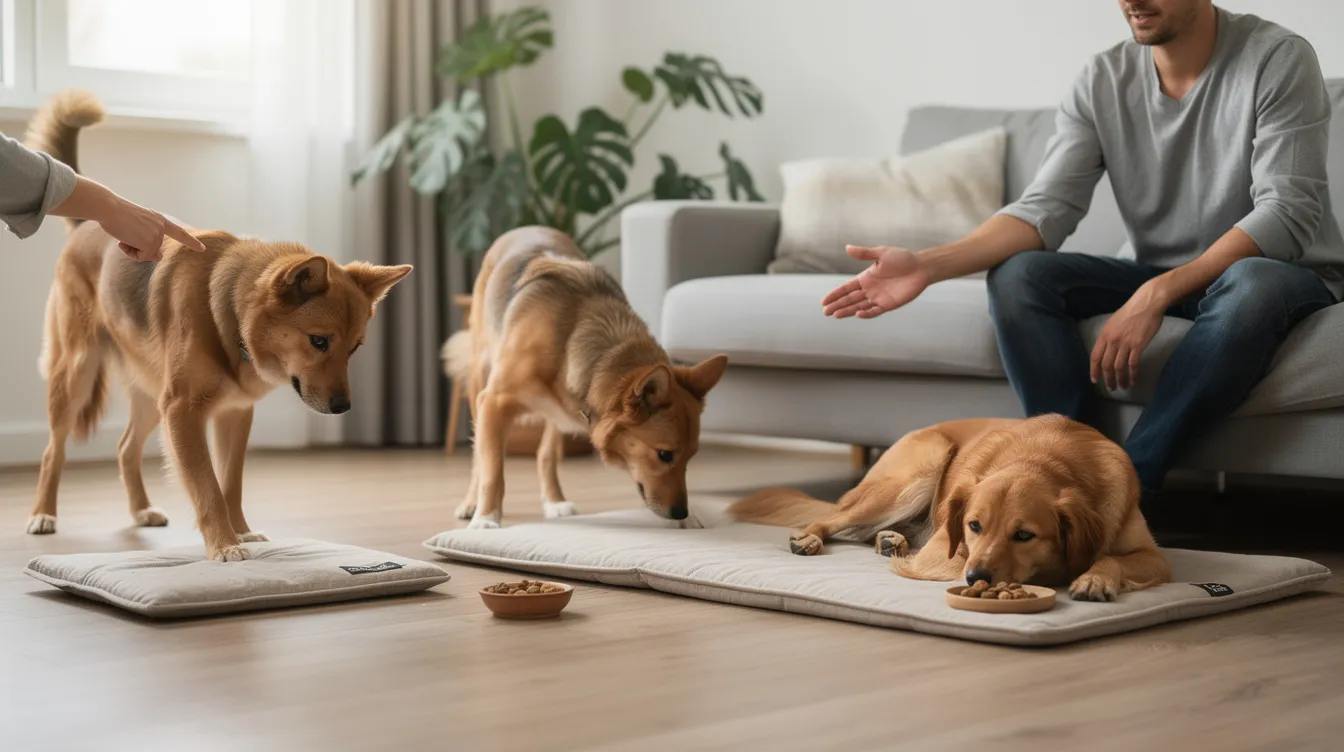
- Place the mat on the floor and reward any interaction. When your dog sniffs, looks at, or puts a single paw on the mat, mark (“yes” or click) and deliver a treat directly on the mat surface. Treats can be delivered on the mat to promote staying down and reinforce that good things happen on this spot.
- Progress from one paw to two paws to all four paws on the mat. Use a tossed treat away from the mat between repetitions to “reset” – your dog leaves the mat, then chooses to return. Each next repetition builds voluntary engagement rather than just static presence.
- Add a sit behavior on the mat with immediate reward and reset. Once your dog steps onto the mat reliably with four feet, wait for a sit before marking. Rewarding natural calm behaviors helps reinforce relaxation on the mat from the earliest stages.
- Build to a reliable four-paws-and-sit combination before advancing. Don’t rush. Your dog should be eagerly returning to the mat and offering a sit without prompting before you move to Phase 2. Introduce the cue when the dog reliably goes to the mat – say “settle” as your dog moves toward the mat, pairing the verbal cue with the behavior they’re already offering.
Phase 2: Adding Down and Duration
With mat targeting solid, you’ll now transition from sit to the down position and begin building the duration that makes settle practically useful.
- Lure your dog from sit to down position while on the mat. Hold a treat at nose level and slowly lower it to the floor between the front paws. The moment the dog lies down, mark and reward. Calm behaviors such as lying down should be rewarded during training.
- Reward the down position and begin 3-second duration holds. Start with a few seconds – mark and treat while the dog lies still. Increase duration gradually to at least 20 seconds on the mat before expecting longer holds.
- Gradually increase duration to 30 seconds, then minutes, with the dog remaining relaxed. Watch your dog’s body language: a truly settled dog has a lowered head, relaxed body, soft eyes. If your dog wanders or stands, you’ve pushed duration too far – drop back to a shorter interval for the next repetition.
- Introduce a release cue to signal the end of settle behavior. Use a release cue like “free” or “okay” to signal when the dog can leave the mat. Using release cues helps dogs understand when the exercise is finished. Dogs should only be on the mat when asked to avoid confusion – this means the settle starts with your cue and ends with your release.
Comparison of Training Approaches
| Training Method | Timeline | Best For | Difficulty Level |
|---|---|---|---|
| Lure-based method | 1–2 weeks for basics | Food-motivated dogs that respond quickly to treat guidance | Beginner-friendly |
| Capturing method | 2–3 weeks for basics | Independent dogs that offer calm behavior naturally | Intermediate |
| Shaping method | 3–4 weeks for basics | Dogs needing confidence building or those with anxiety | Advanced |
The lure-based method gets initial behavior fastest but requires careful fading so your dog responds to the verbal cue alone. Capturing – waiting for your dog to lie down spontaneously and then marking it – promotes intrinsic calm but demands patience and keen observation. Shaping sets incremental criteria (paw on mat, partial down, head lowering, duration) and is favored by many professionals, including KPA faculty member trainers, for building high-quality behavior in small steps. A 2020 study published in Applied Animal Behaviour Science found that dogs trained with reward-based methods had 60% lower cortisol post-session compared to those trained with aversive methods – reinforcing that positive reinforcement produces genuinely relaxed dogs, not just compliant ones.u
Choose your method based on your dog’s temperament: a high-energy puppy may do best with luring, while a cautious rescue dog typically benefits from shaping. With the basics established, it’s time to make this behavior bulletproof.
Advanced Training and Distraction-Proofing
A settle that only works in your quiet living room isn’t truly useful. Real-world reliability means your dog settles on command in any environment, at any distance, amid real distractions – the foundation of genuine off-leash obedience.
Adding Distance and Direction Control
Once your dog responds reliably at close range, begin sending them to the mat from increasing distances. Start at six feet, then 12 feet, then from across the room. Practice from different angles – standing beside the mat, behind it, facing away. Teach dogs to remain on the mat with gradual movement on your part: take one step back, then two, then walk around the room.
Building reliability when the handler is out of sight is critical for practical application. Step behind a doorway for a few seconds, return and reward. Gradually increase your absence. This progression mirrors what your dog will eventually need to do when you’re in the kitchen and they’re settled in the living room – or when you stand up at an outdoor cafe.
Environmental Distractions and Generalization
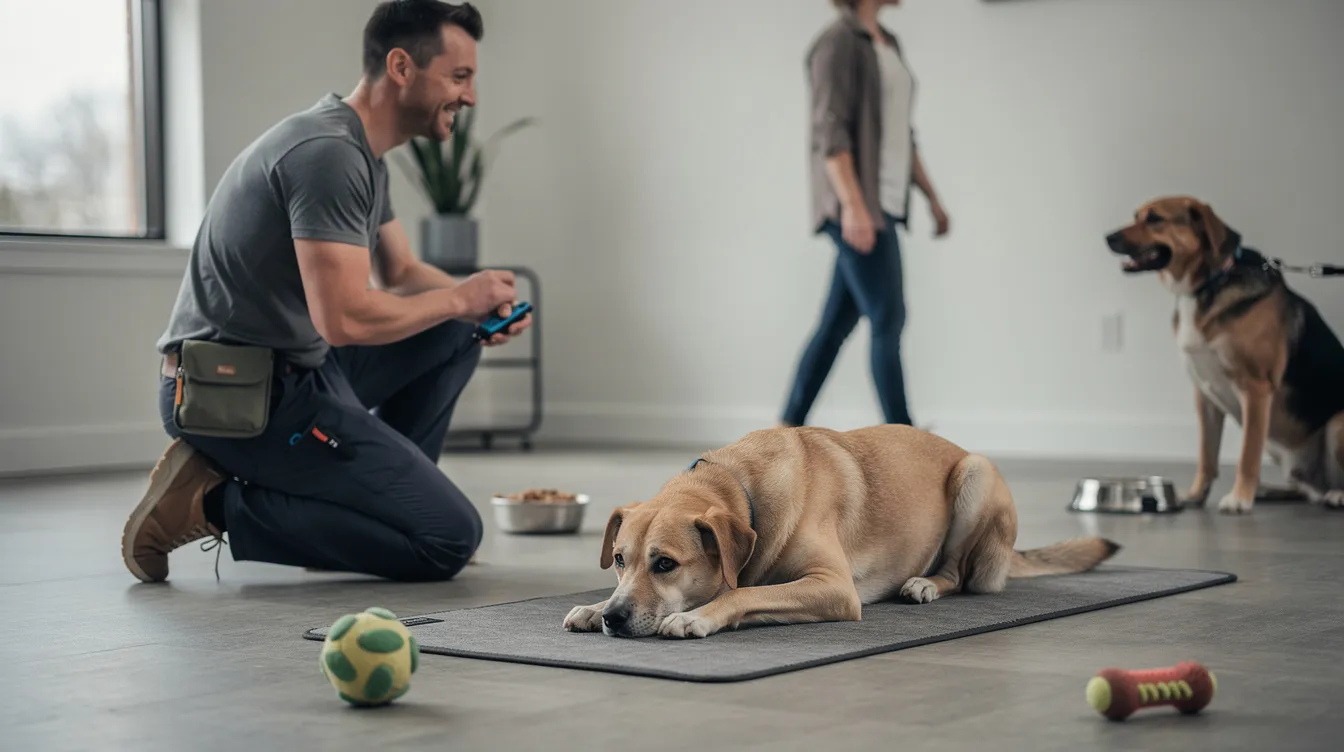
Introduce distractions one at a time during mat training – never stack multiple new challenges simultaneously. Start with mild distractions: someone walking through the room, quiet talking nearby. Progress to practicing in the kitchen during meal prep with food smells and activity. Then train during doorbell rings and visitor arrivals.
Start with short durations in new environments to build success. Carry the same mat to different rooms first – at least 3–5 different rooms – then take it outdoors. Eventually practice in public spaces like cafes and veterinary offices. The mat itself becomes the signal: wherever it appears, your dog knows to settle. Dogs can learn to relax on a mat during stressful events when you’ve built this generalization thoroughly. For Southwest Florida owners, this means your dog settles calmly at dog-friendly restaurants, on patios, and even at the beach – where heat, noise, and distractions are constant.
Training a dog to stay on a mat can improve communication with owners because the behavior creates a clear, predictable structure both dog and human understand.
Integration with Off-Leash Obedience
Settle on mat serves as the foundation for advanced impulse control exercises. Once your dog holds a settle reliably at distance with distractions, you’re building toward the same reliability needed for off-leash recalls, long down-stays, and real-world obedience under pressure.
Using settle as the anchor, you can address jumping, barking, begging, and even counter surfing – replacing unwanted behaviors with a trained alternative. Mat training helps dogs retreat from conflict situations, and using a mat can help manage resource guarding issues by redirecting the dog to a designated safe place rather than allowing guarding behavior to escalate. For owners pursuing military or police-level behavioral outcomes, settle on mat is where that reliability begins.
When challenges arise – and they will – systematic troubleshooting keeps progress on track.
Common Challenges and Solutions
Even with a solid training plan, obstacles appear. Here are the most common issues and how to solve them efficiently.
Dog Won’t Stay on Mat
If your dog gets up too soon, you’ve advanced duration or distractions too quickly. Reduce duration requirements immediately – go back to a point where your dog succeeds consistently, even if that means starting at a few seconds again. Use higher-value rewards (a bully stick for longer duration work, or premium soft treats for short repetitions). Check mat placement: if the mat is near a high-traffic area or a door, move it to a quieter location initially.
Inconsistent Response to Settle Cue
When your dog responds sometimes but not others, practice in lower-distraction environments and ensure an 80% success rate before advancing difficulty. Verify all family members use identical cue words and hand signals. Use a clear cue like “settle” for mat training – don’t alternate between “settle,” “go to bed,” and “place” across different family members.
Excitement or Anxiety Around the Mat
Some dogs, particularly those with separation anxiety or high arousal histories, struggle with the stillness that settle demands. Slow the introduction: have the mat present during feeding time and positive play sessions without asking for any behavior. Use a calm voice and slow treat delivery to encourage genuine relaxation rather than amped-up anticipation. Mat training, combined with counter conditioning and the relaxation protocol developed by Dr. Karen Overall, can help anxious dogs build a positive emotional association with stillness. Dogs with severe anxiety may need supplementary work before expecting reliable settle behavior.
Difficulty Generalizing to New Locations
Practice the identical routine in 3–5 different rooms before attempting outdoor locations. Always bring the familiar mat to new environments rather than expecting behavior on any surface – the mat is the dog’s anchor. In each new environment, start with short durations and lower criteria, then rebuild. Mat training aids in desensitization to new stimuli, but only when you respect the progression.
With consistent practice and patience through these challenges, settle on mat becomes a lifelong skill that forms the backbone of your dog’s obedience foundation.
Conclusion and Next Steps
Dog settle on mat training creates a reliable calm behavior foundation that supports everything from peaceful dinners at home to advanced off-leash obedience in demanding environments. When your dog settles on cue – truly relaxes, not just tolerates a position – you’ve built genuine self-regulation that transfers to every aspect of daily life. Mat training helps dogs learn to relax on cue, and that learned calm pays dividends for years.
Start this week:
- Choose and place your mat in a quiet room today
- Practice Phase 1 mat introduction for just a few minutes, 3–4 times daily
- Progress through phases systematically – don’t advance until your dog succeeds at least 80% of the time
- Introduce your verbal cue once your dog reliably goes to the mat
- Add one distraction at a time, and practice in new locations with the same mat
For those wanting faster results, board-and-train programs provide immersive training that builds deep settle behavior with rapid generalization. If you have a young puppy, starting early through a structured puppy training program gives you the fastest uptake and strongest foundation.
Additional Resources
- Free phone consultation – get a personalized training assessment for your dog’s specific needs and temperament
- Board-and-train programs for accelerated settle training results with professional immersion
- Private lesson scheduling for hands-on guidance in Fort Myers and surrounding Southwest Florida areas
