
Introduction
Dog barking at the doorbell is one of the most frustrating behavioral issues pet owners face – and if you live in Fort Myers or anywhere in Southwest Florida, where frequent visitors, package deliveries, and an active social lifestyle are part of daily life, the problem can feel relentless. Every time the doorbell rings, your dog goes crazy, launching into a frenzy of noise that disrupts your household, embarrasses you in front of guests, and can even create safety risks like door-darting.
This article covers proven, professional-grade training methods for stopping doorbell barking in dogs of any breed, size, or temperament. Whether your dog’s behavior stems from territorial instincts, excitement, or anxiety, you’ll find a clear path forward here. The target audience is any dog owner dealing with excessive barking at the doorbell who wants reliable, real-world results – not temporary fixes that fall apart the first time a delivery person shows up.
Here’s the direct answer: dogs can learn to stop barking at doorbells through consistent desensitization training and redirection techniques that typically show measurable results within 2–4 weeks of daily practice. Research by Sophia Yin et al. (2007) demonstrated that positive reinforcement protocols reduced barking from approximately 19.3 barks per minute to just 2.1 barks per minute in as few as eight days under structured conditions.
By the end of this guide, you will know how to:
- Eliminate doorbell barking through systematic desensitization and counter-conditioning
- Create calm door manners using a reliable place command
- Establish a designated spot your dog moves to automatically when the bell rings
- Improve overall obedience so your dog responds even under high excitement
- Understand when professional behavior modification is the right next step
Understanding Why Dogs Bark at Doorbells
Territorial barking is a deeply rooted canine behavior with evolutionary origins. Dogs evolved as social animals whose role within the pack included alerting others to potential intruders. In a modern home, your dog views their house as territory, and the doorbell signals an approaching stranger on the other side of the front door. That instinct to bark – to announce, warn, and mobilize – hasn’t faded just because your dog now sleeps on the couch.
Understanding the root cause of your dog’s response is essential before choosing the right training approach. Doorbell barking typically falls into three categories, and many dogs experience a combination of all three.
Natural Alert Response
When the sound of the doorbell reaches your dog’s ears, it triggers an immediate nervous system response. The sudden doorbell noise activates the brainstem’s startle reflex, which then signals the hypothalamus to release adrenaline and cortisol – the same fight-or-flight hormones that helped wild canids survive encounters with threats. Your dog’s body floods with arousal chemicals, and barking becomes the instinctive outlet.
Dogs bark at the doorbell due to territorial protection instincts. This alert response connects directly to pack protection behaviors: your dog is essentially telling everyone in the house, “Someone is here.” The behavior is self-reinforcing because, from your dog’s perspective, the barking successfully scares away the intruder – after all, the mail carrier always leaves. Self-reinforcement occurs every time barking coincides with the person on the other side departing.
Learned Excitement Patterns
Beyond instinct, dogs often associate the doorbell with unpredictability and excitement. Barking at the doorbell can be a learned habit due to classical conditioning: the ding dong predicts visitors arriving, which means petting, attention, and potential play. Excited dogs may bark in anticipation of visitors at the door because they’ve learned that the doorbell means something thrilling is about to happen.
Dogs associate visitors with potential play or attention, leading to excitement that compounds with each repetition. Every time you rush to the door, yell over the barking, or scold your dog, you may accidentally reinforce the behavior. The AKC notes that owners can unintentionally reward barking simply by reacting – even negative attention registers as socially engaging for many dogs.
Anxiety and Overstimulation Factors
Some dogs react to doorbell sounds with anxiety rather than excitement. For noise-sensitive or fearful dogs, the doorbell isn’t an announcement – it’s a perceived threat. Signs include shaking, panting, lip licking, avoidance, and a preference to retreat rather than approach the door. Dogs may react to doorbell sounds with excitement or anxiety, and the distinction matters because the training approach must account for the emotional state driving the behavior.
There is a threshold at which any stimulus goes from merely alerting to overwhelming. Dogs consistently pushed past that threshold become harder to train over time because their stress response deepens. Fortunately, this is exactly what systematic desensitization and counter-conditioning are designed to address – which brings us to the professional methods that actually work.
Professional Training Methods for Doorbell Barking
Now that you understand the territorial, learned, and emotional roots of doorbell barking, the next step is applying structured training methods that address all three. The most effective protocols combine desensitization, place command training, and counter-conditioning into a unified system. These aren’t quick tricks – they’re the same techniques used in behavior modification programs by professional trainers and veterinary behaviorists.
Desensitization Training Protocol
Desensitization helps change a dog’s emotional response to the doorbell by exposing them to the trigger at an intensity low enough to keep them under their reaction threshold. Use a recorded doorbell sound for training sessions, starting at very low volume while your dog is in a neutral, relaxed state.
The process works like this: play the recorded doorbell sounds softly – quiet enough that your dog notices but doesn’t react – and immediately reward calm behavior with a high value treat. It’s important to gradually increase the volume of the doorbell in training sessions, progressing only when your dog remains calm at the current level. If your dog starts barking, you’ve pushed too fast; reduce volume and repeat. Physiological signs of stress – panting, averted gaze, trembling – should be completely absent before moving to the next intensity level. Veterinary behavior protocols emphasize that this graded exposure hierarchy should extend from soft knocking all the way through a real person stepping through the doorway.
Practice for 3–5 minutes during doorbell training sessions. A fixed routine of short training sessions is more effective than lengthy ones. Two to three sessions per day, kept brief and positive, will build reliable results faster than one long, exhausting exercise.
Place Command Foundation
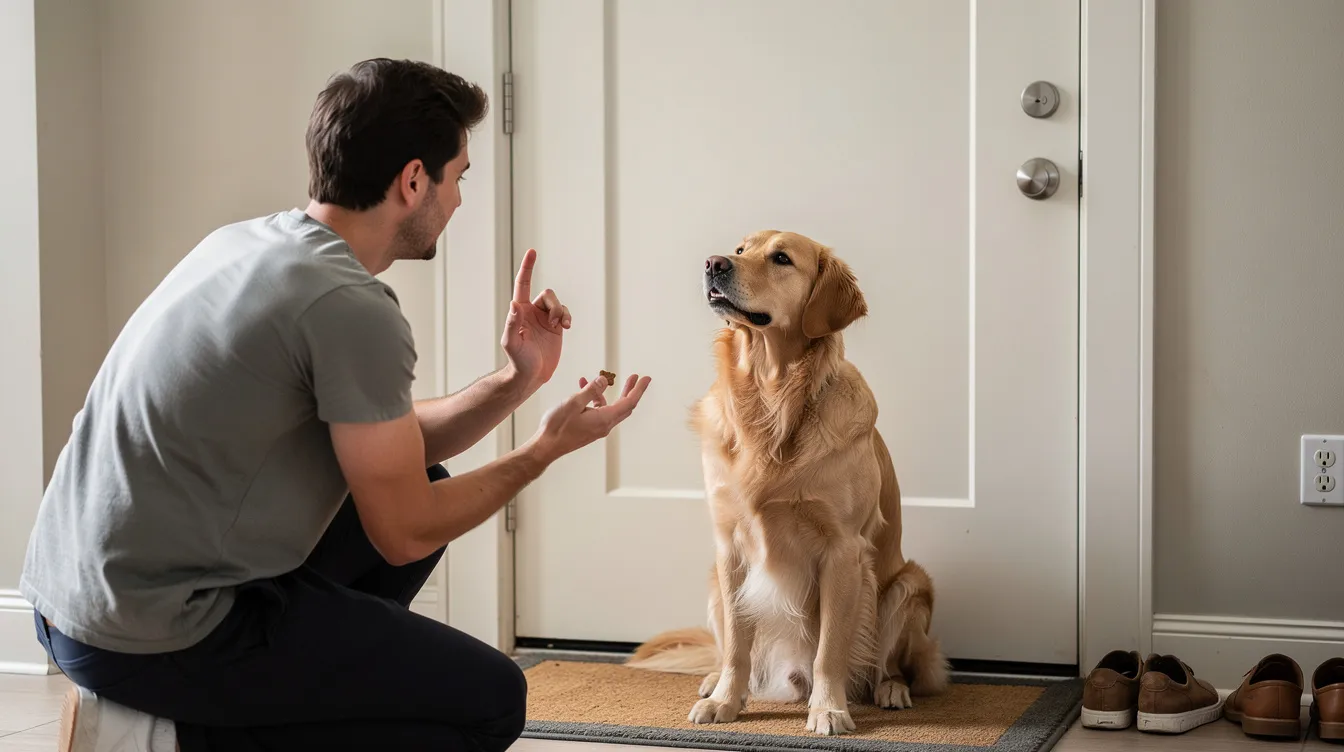
Teach your dog to go to a designated spot when the doorbell rings. This gives your dog an incompatible behavior – they cannot bark frantically at the front door while lying calmly on a bed or mat across the room. The place command creates structure, reinforces impulse control, and provides a clear answer to “what should I do instead?”
Practice sit and stay at a designated spot by the door, using consistent verbal cues. Use a special cue like “let’s go see” or “place” for training so your dog learns exactly where to go. Reward your dog for staying in their designated spot with treats and calm praise. The 3 simple dog commands you can try at home – including place – form the foundation for this kind of reliable redirection.
In the Yin et al. study, dogs trained to run to a designated platform and lie down during doorbell triggers reduced their proximity to the door from 84.5% of the time to essentially zero. That’s the power of an established place command paired with consistent reinforcement.
Counter-Conditioning with Positive Associations
Counter-conditioning works alongside desensitization by replacing the emotional response itself. The goal is to teach your dog that the doorbell means something wonderful – not something to worry about or react to. Calm dogs can be trained to associate the doorbell with treats, so that over time, hearing the bell triggers anticipation of a reward rather than a barking frenzy.
Immediate rewards for staying calm are crucial when the doorbell rings. The timing must be precise: treat delivery should happen within one to two seconds of the calm behavior you want to reinforce. Rewarding calm behavior is essential in altering barking habits, and the treats should be high-value – freeze-dried liver, cooked chicken, or something your dog doesn’t normally eat during regular meals.
Key points to remember:
- Start counter-conditioning at low stimulus intensity, just like desensitization
- Variable reinforcement (sometimes treats, sometimes praise) builds long-term reliability
- Training an alternative behavior – like going to a designated spot – gives the counter-conditioning a concrete target
- Consistency across every family member is non-negotiable
These foundational methods set the stage for real-world application, which requires a structured implementation plan.
Advanced Implementation and Real-World Application
With the core training methods established, the next step is applying them in realistic conditions. The gap between a dog who stays calm during practice and one who holds it together when an actual person rings the real doorbell is where most owners struggle. Bridging that gap requires a deliberate, progressive protocol.
Step-by-Step Training Procedure
Begin this protocol once your dog has a basic understanding of the place command and has been introduced to recorded doorbell sounds at low volume. Management strategies can prevent dogs from rehearsing unwanted behaviors during the training process – so between sessions, consider using baby gates or a leash to prevent your dog from practicing the old barking pattern at the front door.
- Record doorbell sound and set up training area. Use your phone to record your actual doorbell or download a doorbell sound. Set up a training space with your dog’s designated spot (bed, mat, or crate) positioned away from the door, with high value treats ready.
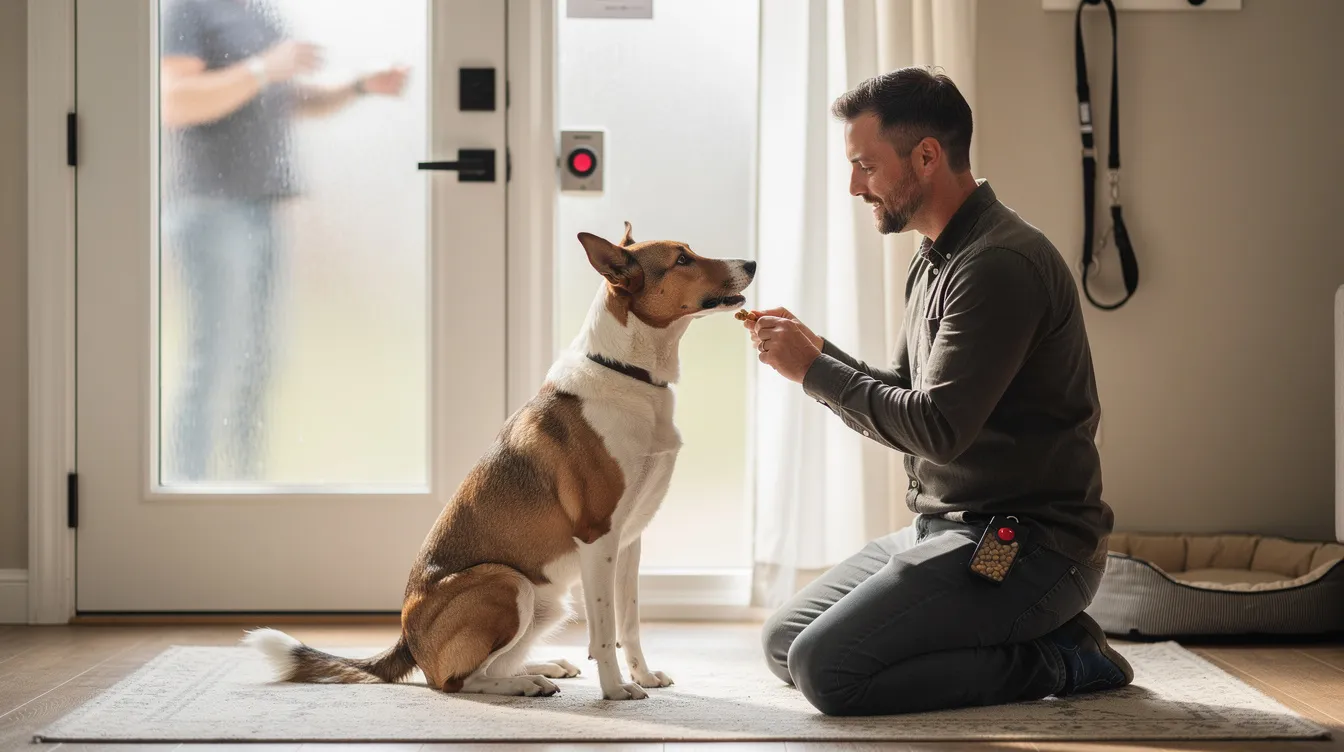
- Begin low-volume exposure with treat rewards. Play the doorbell sound at minimal volume. The instant your dog hears it without reacting, mark the behavior (“yes” or a clicker) and deliver a treat. Reward your dog with treats for remaining calm at the doorbell. Repeat five to eight times per session.
- Gradually increase volume while maintaining calm response. Over several days, raise the volume incrementally. If your dog starts to react, reduce volume and repeat the previous level. Wait until your dog is confident and relaxed before progressing. Each session should last 3–5 minutes.
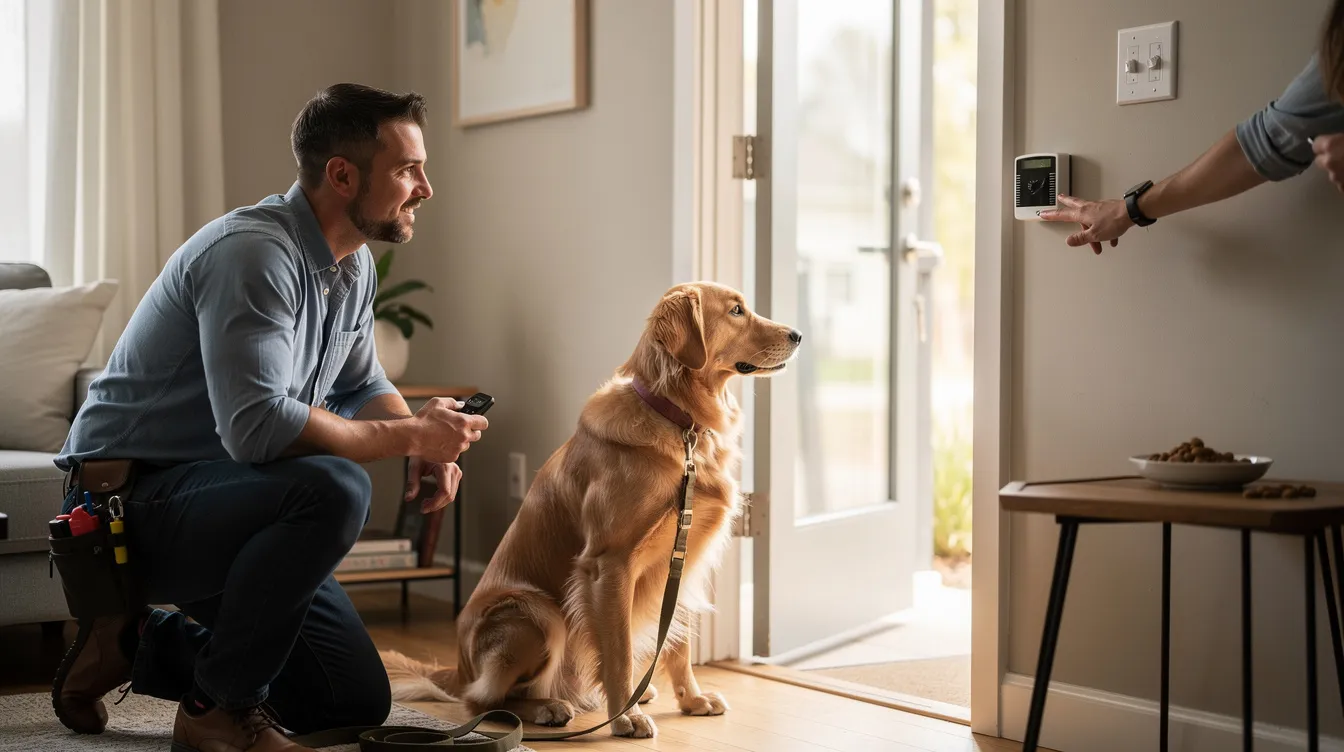
- Practice with a real doorbell using a helper. Practice with a friend ringing the doorbell to simulate real-life situations for training. Have your helper ring the bell while you cue your dog to their designated spot. Reward calm behavior immediately. Introduce varying patterns – single rings, double rings, a knock – to generalize the response.
- Test with actual visitors and deliveries. The final stage involves real guests arriving at your door. Cue your dog to place, open the door, and reward. If your dog breaks position, calmly reset without punishment. Over time, the process becomes automatic – doorbell rings, dog goes to their spot.
Training Method Comparison
Not all approaches to doorbell barking are equal. Here’s how the most common methods compare:
| Criterion | Traditional Correction | Positive Reinforcement | Professional Behavior Modification |
|---|---|---|---|
| Timeline | Fast initial suppression (days) | Gradual improvement (2–4 weeks) | Accelerated results (1–2 weeks with follow-up) |
| Long-term reliability | Often poor; rebound barking common | High with consistency | Highest when owner follows through |
| Risk of side effects | Increased fear, anxiety, trust damage | Minimal | Minimal under qualified trainer |
| Best for | Rarely recommended | Most dogs and owners | Severe or deeply ingrained cases |
| Owner skill required | Low (but outcomes are unreliable) | Moderate – timing and consistency matter | Low during program; moderate for maintenance |
The synthesis is clear: positive reinforcement combined with desensitization produces the most sustainable results for the majority of dogs. For severe cases – dogs with deep anxiety, aggression at the door, or multi-dog households where pack excitement spirals – professional behavior modification board-and-train programs deliver faster, more reliable outcomes because the dog learns in a controlled environment with expert timing and structure.
Common Challenges and Solutions
Even with the right methods, obstacles arise. Here are the most common challenges owners face during doorbell training and how to address each one.
Dog Ignores Commands During High Excitement
When arousal is high, a dog’s ability to process cues drops dramatically. If your dog ignores the place command when someone actually rings the bell, the solution is to increase distance from the door during training and build impulse control through foundational exercises like “wait” and “leave it.” Dogs need to learn control at low intensity before it generalizes to high-intensity triggers. Note that dogs need 60–90 minutes of exercise daily – a dog with pent-up energy will have a much harder time maintaining calm behavior. A good walk or play session before training sessions can dramatically improve results.
For dogs with severe reactivity, private dog training or a board-and-train program provides the intensive, controlled environment needed to break through deeply entrenched patterns. A large-scale survey of over 43,500 dogs found that 14–28% of U.S. dogs exhibit moderate to severe anxiety or fear responses, so if your dog falls into that category, professional intervention is not an overreaction – it’s appropriate.
Multiple Dogs Creating Pack Excitement
When one dog reacts to the doorbell, the other dogs in the house often join in – a phenomenon called social facilitation. The barking escalates into a feedback loop that’s nearly impossible to interrupt in the moment. The solution: train each dog individually first. Build a solid place command and desensitization response in each dog separately before practicing together. When you reintegrate, pair a calm, trained dog with one still learning. Gradually build up to the full group.
Inconsistent Family Member Participation
Consistency is key for teaching doorbell manners to dogs, and inconsistency is the single fastest way to sabotage progress. If one person in your family rewards the dog for staying on their bed while another yells at the dog to be quiet, the mixed signals confuse the dog and delay – or completely prevent – improvement.
Establish a household protocol: everyone uses the same cue words, the same designated spot, the same reward timing. Post the protocol on the refrigerator if needed. Every person in the house must understand that encouraging or reacting to barking – even once – undermines what you’ve built. If getting the whole family on the same page feels impossible, consider bringing in a professional who can work with your entire household and establish unified expectations.
Conclusion and Next Steps
Barking at the doorbell is not a life sentence for you or your dog. It’s a trainable, modifiable behavior rooted in instinct, learned associations, and emotional arousal – all of which respond to structured desensitization, counter-conditioning, and a reliable place command. With patient, consistent effort, most dogs show significant improvement within two to four weeks.
Your immediate action steps:
- Record your doorbell sound on your phone today
- Establish a designated spot (bed or mat) away from your front door
- Begin 3–5 minute daily training sessions at low volume, rewarding calm behavior
- Recruit a friend or family member to serve as a helper for real-doorbell practice within the first week
- Ensure every person in your household understands and follows the same protocol
If your dog’s doorbell reaction involves aggression, extreme anxiety, or you’ve been working on this for weeks without progress, it may be time for professional support. Off Leash K9 Training Fort Myers offers a free phone consultation to assess your dog’s specific situation and recommend the right program – whether that’s private lessons, a behavior modification board-and-train, or basic obedience training that builds the foundation for a successful, calm life at home.
Additional Resources
- Behavior Modification Board & Train – intensive programs for severe doorbell reactivity, aggression, or anxiety-based barking in Southwest Florida
- Mistakes Dog Owners Make With Reactive Dogs – common errors that accidentally reinforce the behaviors you’re trying to eliminate
- Separation Anxiety in Dogs: Training Techniques – related anxiety-based behavior issues that often overlap with doorbell reactivity
- PAWS Program: Calm at the Door Guide – non-profit resource on desensitization and counter-conditioning protocols
- Contact Off Leash K9 Training Fort Myers for a free consultation and personalized assessment of your dog’s doorbell behavior
