
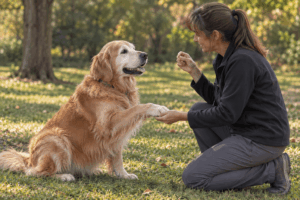
Senior dogs can continue learning new commands and behaviors, although age can affect performance differently depending on the task and the individual dog. A study of 115 pet dogs over six years old found no significant effect of age or lifelong training on learning speed in a specific picture-discrimination task. Other research has found age-related slowing in more demanding discrimination and reversal-learning tasks. The evidence supports continued learning in older dogs, but not the idea that every senior dog learns at the same pace.
This guide covers training methods, health considerations, and practical strategies for older dogs. There is no single age at which every dog becomes senior because aging varies by breed, size, and expected lifespan. AAHA defines the senior life stage as the last 25% of a dog’s estimated lifespan. This guide is written for dog owners in Southwest Florida who want reliable obedience and behavior support for aging pets, with training adapted to each dog’s physical and cognitive needs.
The direct answer: senior dogs can continue to learn, but training should be adapted to the individual. Many benefit from reward-based teaching, shorter sessions, clear communication, and accommodations for pain, hearing loss, vision changes, or cognitive decline. Some older dogs may take longer on certain tasks, while others learn readily; there is no supported rule that senior dogs universally need twice as much time as younger dogs.
By the end of this guide, you will understand:
- How aging can affect your dog’s mental and physical capabilities
- Which training approaches can minimize unnecessary stress and physical strain
- How to adapt communication for hearing loss, vision decline, or cognitive slowing
- What professional training program options exist and how they compare for senior dogs
- How to address common challenges such as arthritis, established habits, and sensory decline
Understanding Senior Dog Learning Capabilities
Dogs remain capable of learning throughout life, although cognitive aging varies by individual and task. Research on aged dogs suggests that environmental enrichment—including physical activity, social interaction, and cognitive stimulation—can support cognitive function. Experimental work has also linked enrichment, particularly when combined with dietary interventions, with changes in BDNF and reduced hippocampal neuron loss. These findings support age-appropriate mental enrichment, but they do not prove that training alone prevents or reverses cognitive decline.
Cognitive Function in Senior Dogs
A senior dog’s brain can undergo age-related changes, and dogs with cognitive dysfunction may show cerebral atrophy, amyloid-beta accumulation, and declines in memory, learning, attention, or executive function. Research has detected mild impairments in some spatial learning and memory tasks as early as around six years in studied dogs, but this does not mean every dog shows clinically meaningful decline at that age. Hearing loss, vision loss, pain, and other medical problems can also affect behavior and apparent trainability.
Simple associative learning may remain relatively preserved in healthy senior dogs, while performance on more complex tasks can slow with age. A study of 107 dogs found that younger dogs learned discrimination and reversal tasks faster than older dogs. Separately, research involving 185 older pet dogs associated greater lifelong training experience with some measures of sustained and selective attention, but that finding should not be interpreted as proof that previously trained senior dogs always learn new tasks faster.
Training for senior dogs should emphasize comfort, confidence, and mental engagement. Predictable routines and appropriate enrichment can be useful, especially when a dog is experiencing age-related changes. New confusion, anxiety, house-soiling, altered social behavior, or sleep changes should also be discussed with a veterinarian because they may reflect pain, sensory loss, cognitive dysfunction, or another medical condition.
Physical Capabilities and Limitations
The age at which a dog becomes senior varies by breed, size, and expected lifespan, so fixed age cutoffs do not apply to every dog. Physical changes also vary widely. Osteoarthritis is common in dogs, and age, body size, weight, and orthopedic history can influence risk. Pain or reduced mobility can make repeated sit-to-stand transitions, long stays on hard surfaces, jumping, or other high-impact movements uncomfortable, so training should be adjusted to the dog’s mobility and veterinary guidance.
Sensory changes can compound the challenge. Dogs with hearing loss may become startled by unexpected touch, while dogs with vision loss may have difficulty navigating stairs, furniture, or unfamiliar spaces. Stamina also varies from dog to dog. Rather than assuming a fixed session length, watch for signs of fatigue, pain, stress, or disengagement. What looks like stubbornness can sometimes reflect discomfort, hearing loss, vision changes, or cognitive decline.
These limitations do not necessarily end training; they change how training should be approached.
Age-Appropriate Training Methods
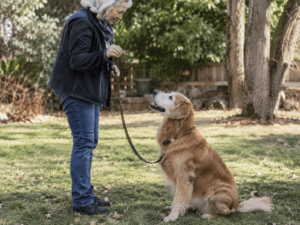
Training senior dogs often works best with brief, low-impact sessions that can be adjusted to the dog’s comfort and stamina. The goal is to keep learning manageable while using clear communication and rewards that are appropriate for the individual dog.
Reward-Based Training Techniques
Reward-based training is a well-supported approach for senior dogs, especially when comfort and motivation are priorities. A study of 92 dogs compared reward-based, mixed, and aversive-based training methods. Dogs in the aversive group showed more stress-related behaviors and greater post-training increases in cortisol than dogs in the reward-based group, and they also showed more pessimistic responses in a cognitive-bias task.
These welfare findings are especially relevant for older dogs that may already be coping with pain or sensory changes. Reward-based methods can help maintain engagement without adding unnecessary stress. The training plan should still be individualized, and any tools or physical handling should be appropriate for the dog’s health, temperament, and comfort.
Practical application of reward-based training for seniors:
- Use high-value rewards that are easy for your dog to consume and appropriate for any dietary or dental restrictions.
- Mark desired behaviors promptly using a clicker, verbal marker such as “yes,” or a visual marker for a dog with hearing loss. Research supports conditioned reinforcers as useful training tools, but it does not establish that clickers universally accelerate learning compared with other well-timed reward methods.
- Reward small approximations when teaching a new behavior. If your dog walks toward a mat but does not lie down, for example, reinforce that first step and build gradually.
- Keep rewards meaningful to the individual dog. Food, praise, play, or another appropriate reinforcer may work depending on the dog’s preferences and health.
Session Structure and Duration
There is no single session length that fits every senior dog. A practical starting point is about 5 to 10 minutes, with even shorter sessions for dogs that fatigue, become sore, or lose interest. Some seniors can comfortably work longer. Keep sessions short enough that your dog remains engaged, and stop if you notice physical or mental fatigue.
Establishing a predictable training routine can be helpful, but frequency should be based on your dog’s comfort and your schedule rather than a fixed requirement. Several brief sessions spaced through the day may be easier on a senior dog than one long session. Monitor for slowing responses, avoidance, unusual panting, difficulty changing positions, or lying down, and stop when your dog appears mentally or physically tired.
In Southwest Florida, timing matters beyond session length. Training during cooler morning or evening hours can make outdoor work more comfortable. Hot pavement can injure paws, and heat can increase fatigue. Indoor sessions on secure, non-slip surfaces are useful when outdoor conditions are uncomfortable.
Communication Adaptations
Training should adapt for sensory changes in senior dogs with hearing or vision loss.
For dogs with hearing loss, hand signals and other visual cues can replace or supplement verbal cues. If hearing is declining gradually, pairing visual signals with familiar verbal cues can make the transition easier. Teach a reliable visual attention signal so the dog checks in before you give another cue. Consistent, gentle touch or floor vibration can also be conditioned as attention signals, but avoid startling the dog.
For dogs losing vision, keep furniture and household layout consistent. Non-slip rugs or textured mats can provide useful landmarks, and unsafe stairs or other hazards may need to be blocked. Ramps or other mobility aids can help some dogs when appropriate. Verbal and tactile cues can assist with navigation, and a reliable stay cue can improve safety around hazards.
For cognitive slowing, simplify communication. Use clear cues and avoid rapidly chaining several commands together. Give your dog enough time to process the cue before repeating or changing it. Reward correct responses to maintain clarity and confidence.
Implementing Professional Training Programs
Off Leash K9 Training in Fort Myers currently lists private lessons, adult Board & Train, Day Board & Train, puppy programs, behavior modification, and therapy dog preparation. Its service information says programs are matched to factors such as age, behavior, temperament, and training goals. For a senior dog, program selection should also account for mobility, sensory changes, medical conditions, and how well the dog tolerates changes in routine or environment.
Basic Obedience Foundation
Older dogs may have long-practiced behaviors, so training often focuses on reinforcing a more useful alternative rather than “untraining” a habit. A foundation of basic commands can improve communication and help owners manage daily routines safely.
- Build clear everyday cues. Sit, stay, down, or another comfortable stationary behavior can help manage doors, visitors, and other daily situations. Choose positions your dog can perform without pain and use a padded or non-slip surface when needed.
- Practice recall safely. Start with a long line or secure fenced area and gradually add appropriate distractions. Off-leash work should only be considered when it is safe and appropriate for the individual dog; hearing or vision loss may require additional precautions.
- Practice comfortable loose-leash walking. Use equipment that fits properly and is appropriate for your dog’s health and handling needs. Keep activity low-impact and adjust walk duration, surface, and pace if your senior dog has mobility limitations.
- Use a comfortable place or settle behavior. A padded mat or bed can provide a predictable resting location around visitors or household activity. If repeatedly getting up or lying down is uncomfortable, adapt the behavior to your dog’s mobility.
Training Method Comparison
Choosing between training formats depends on your senior dog’s temperament, health, routine, and your preferred level of involvement.
| Factor | Board & Train | Private Lessons |
| Training Setting | Dog stays with a professional trainer for an immersive program | Owner and dog work directly with the trainer during scheduled lessons |
| Owner Involvement | Owner education and transfer work are especially important when the dog returns home | Owner participates directly and practices between lessons |
| Routine Change | Requires a larger temporary change in the dog’s normal routine | Dog generally remains in its normal home routine outside training |
| Senior-Dog Considerations | Health, mobility, temperament, medication needs, and tolerance for boarding should be reviewed | Health and mobility still matter, but training can be adjusted progressively with the owner involved |
For some senior dogs, private lessons may be easier to integrate because the dog remains in its normal routine outside training sessions. Board & Train programs provide a more immersive format for eligible dogs. Fort Myers also currently lists an Adult Day Board & Train option in which dogs train during the day and return home afterward, subject to trainer and owner scheduling. Program suitability for a senior dog should be based on the dog’s health, temperament, mobility, and training needs.
Long-term maintenance also depends on owner follow-through and continued practice. The Fort Myers service information notes that results can vary based on factors such as a dog’s age, history, temperament, and the owner’s follow-through.
Common Challenges and Solutions
Every senior dog brings a different combination of health, behavioral history, temperament, and previous training experience. Several challenges deserve particular attention.
Arthritis and Mobility Issues
Osteoarthritis is common in dogs, and age, body weight, size, and orthopedic history can influence risk. If a senior dog has pain or reduced mobility, avoid repetitive jumping and other high-impact drills. Use non-slip surfaces, provide comfortable resting areas, and consider ramps or other environmental modifications when appropriate for the individual dog. Training positions should be chosen for comfort rather than forcing repeated sits, downs, or transitions.
Before starting or substantially changing training for a senior dog with stiffness, pain, lameness, or reduced endurance, schedule a veterinary exam. Your veterinarian can evaluate mobility and recommend an appropriate management plan when needed. Canine osteoarthritis guidelines support individualized exercise and, when appropriate, rehabilitation or physical therapy. Training may include gentle movement, but it should not be presented as a treatment for arthritis unless the exercise plan is designed with veterinary or rehabilitation guidance.
Hearing or Vision Loss
Hand signals can replace verbal cues for dogs with hearing loss. There is no single required set of signals; what matters is that each cue is distinct and used consistently. Touch or floor vibration can also be conditioned as an attention signal. Vibration collars should be introduced cautiously because some dogs may find the sensation aversive.
For vision loss, the priority shifts to spatial predictability. Keep furniture in consistent positions and block unsafe stairs, pools, or other hazards when needed. Textured mats can provide landmarks, and verbal or tactile cues can help with navigation. If scent markers are used, choose dog-safe options and prevent ingestion rather than applying essential oils around food, water, or bedding. Appropriate scent-based enrichment can also give a visually impaired dog an activity that does not depend on sight.
Established Bad Habits
An older dog that has spent years charging the door when the doorbell rings has a long reinforcement history behind that behavior. Rather than relying on punishment, teach and reinforce an alternative behavior, such as going to a mat or bed when the doorbell sounds. Work in small steps so the dog can succeed, and adapt the setup for hearing, mobility, or cognitive changes.
For reactivity toward dogs or people, behavior work should begin at a distance or intensity where the dog can remain below threshold and progress gradually from there. A fixed distance is not appropriate for every dog. New or worsening aggression in a senior dog warrants veterinary evaluation because pain, sensory loss, or other medical changes can contribute. Complex aggression cases should be handled with qualified professional guidance.
Conclusion and Next Steps
Senior dogs can continue learning with an approach adapted to their individual abilities. Training can provide mental engagement, reinforce useful everyday behaviors, and give owners a structured way to interact with their dogs. Keep sessions manageable, use rewarding and clear communication, adapt exercises to sensory or mobility changes, and involve your veterinarian when health concerns may affect training.
Your immediate next steps:
- Schedule a veterinary exam if your senior dog has not been evaluated recently or if you have noticed changes in mobility, hearing, vision, cognition, dental health, or behavior.
- Identify your top two or three behavior goals, such as recall reliability, leash manners, visitor behavior, or another practical skill.
- Start with brief sessions at home using appropriate rewards, and adjust the duration to your dog’s comfort and attention. Keep simple notes on progress so you can identify improvements or changes that may need professional attention.
- Contact a professional trainer experienced with older dogs if you need help choosing exercises or a training format that accounts for your dog’s age, health, and behavioral history.
Related topics worth exploring include therapy dog preparation for seniors who are medically and behaviorally suitable, veterinarian-guided nutrition for healthy aging, and home or grooming routines adapted to mobility and sensory changes.
Frequently Asked Questions
Can senior dogs learn new commands?
Yes. Senior dogs can continue learning new commands and behaviors. Some may take longer on certain tasks, particularly when cognitive, sensory, or mobility changes are present, while other older dogs learn new skills readily.
How long should training sessions be for senior dogs?
Training sessions should be kept short enough that your senior dog remains comfortable and engaged. Around 5 to 10 minutes can be a practical starting point, but some dogs need shorter sessions and others can comfortably work longer.
What are the best training methods for older dogs?
Reward-based training is a well-supported approach for senior dogs and can help maintain engagement while minimizing unnecessary stress. Methods should still be adapted to the dog’s health, temperament, and comfort.
How do you adapt training for senior dogs with hearing or vision loss?
Use clear hand signals and other visual cues for dogs with hearing loss. For dogs with vision loss, consistent home layouts, verbal or tactile cues, textured landmarks, and appropriate safety barriers can help. Adapt each cue to the senses your dog can use reliably.
Is crate training suitable for senior dogs?
Crate training can be suitable if a senior dog is already comfortable with a crate or is introduced to it gradually and positively. Dogs with arthritis, incontinence, anxiety, or cognitive changes may need an adapted setup or a different confinement option. Sudden house-soiling in an older dog should be discussed with a veterinarian rather than treated only as a training problem.
Can training improve joint mobility in senior dogs?
Low-impact, appropriately selected movement can support mobility in senior dogs, but ordinary training should not be treated as therapy for arthritis or joint disease. Dogs with pain or mobility problems should have their exercise plan reviewed by a veterinarian or qualified rehabilitation professional.
