
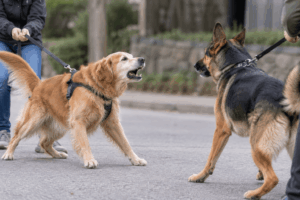
Leash reactivity and aggression are related but not interchangeable behavioral terms, and confusing them can lead to inappropriate handling or training decisions. Understanding leash reactivity vs. aggression is an important first step toward choosing safer management and training strategies for your dog.
This article covers the behavioral differences between reactivity and aggression, factors that may contribute to each, how the leash environment can shape your dog’s behavior, and practical training and management strategies. It’s written for dog owners throughout Southwest Florida, particularly Fort Myers, Cape Coral, and surrounding areas who are dealing with challenging on-leash behaviors and want a clearer path forward.
Here’s the core distinction: leash reactivity describes a high-arousal response to triggers while a dog is restrained, which may include barking, lunging, growling, whining, pulling, or stiffening. Aggression describes threatening behavior or the use of force, which can include growling, snarling, snapping, lunging, or biting. The two can overlap, and both may involve emotions such as fear or frustration. Resource guarding, territorial behavior, pain, previous learning, and other factors may also contribute to aggression. The Merck Veterinary Manual’s overview of canine behavior problems provides additional information about the different motivations and medical factors that can contribute to aggression.
By the end of this article, you’ll be able to:
- Identify behavioral differences between leash reactivity and aggressive behavior
- Understand contributing factors including fear, frustration, pain, and socialization history
- Implement appropriate training and management responses based on your dog’s behavior
- Recognize when to seek professional help because of escalating behavior or bite risk
- Reduce escalation risk through safer management and appropriate training
Understanding Leash Reactivity and Aggression
Leash reactivity is a commonly used term for rapid, high-arousal responses to stimuli while a dog is on leash. Recent research on dog reactivity examined behaviors including barking, growling, snarling, lunging, snapping, nipping, biting, whining, and stiff posturing. When a reactive dog spots another dog, a jogger, or a child on a bicycle, they may bark, lunge, pull, whine, stiffen, or spin. Fear, frustration, excitement, or a combination of factors can contribute. These behaviors do not, by themselves, determine whether the dog is likely to escalate to snapping or biting.
Aggression, by contrast, refers to behavior involving the threat or use of force. It can range from threatening postures, growling, or snarling to snapping and biting. Aggression may be related to fear or anxiety, resource guarding, frustration, territorial behavior, pain, conflict, or previous learning. It can occur only in a particular context, including while on leash, or appear in multiple situations. Merck’s veterinary guidance on aggression in dogs discusses fear, learning, pain, resource guarding, frustration, and other possible contributing factors.
For Fort Myers-area owners, understanding the difference matters for both daily walks and overall safety. Two dogs may both bark and lunge at another dog while requiring different levels of risk management depending on their triggers, behavior history, recovery, and any history of snapping or biting. Accurate assessment helps determine appropriate distance, equipment, training setup, and professional involvement.
Leash Reactivity Characteristics
Common signs of leash reactivity include barking at triggers, lunging toward or away from stimuli, pulling hard against the leash, spinning, whining, freezing, stiffening, or raising the hackles. These signs can reflect heightened arousal, fear, frustration, excitement, or conflict, but individual behaviors should not be used by themselves to determine aggression risk.
Factors behind reactive behavior can include fear, frustration, barrier-related frustration, overstimulation, previous experiences, genetics, and socialization history. A dog that has had a frightening encounter with another dog may become more reactive during future encounters. Frustration can also contribute when a dog is restrained and unable to approach or move away. Limited or inappropriate socialization during development may increase the likelihood of fearful or reactive responses to unfamiliar situations.
The leash itself can be an important factor. Restraint limits a dog’s ability to change distance, retreat, or approach a situation freely, and leash tension or restricted movement may affect an interaction. For a dog already experiencing fear, frustration, or high arousal, those limitations can contribute to a stronger reaction. The Merck Veterinary Manual explains that frustration can occur when a dog is prevented from completing a behavior, including because of physical barriers or restraint.
Aggression Characteristics
Aggressive behavior can include stiff posture, intense staring, growling, snarling, lunging, snapping, or biting. Some dogs may appear defensive or conflicted, while others move forward more confidently. Appearance alone does not reveal the dog’s underlying motivation.
Aggressive behavior may occur with resource guarding, fear or defensive responses, territorial behavior, conflict, frustration, redirected behavior, pain, or other factors. Aggression does not have to occur across multiple contexts to qualify as aggressive behavior; some dogs show it only around particular triggers, resources, locations, or leash situations.
Reactivity and aggression can overlap, and repeated high-arousal encounters may increase the risk of escalation in some dogs. Lower-level warning signals such as growling, stiffening, or other signs of discomfort should not simply be punished or suppressed, because doing so does not address the underlying fear, frustration, or conflict. The American Veterinary Society of Animal Behavior’s guidance on humane dog training recommends reward-based approaches and cautions against aversive training methods. Understanding the dog’s complete behavior pattern supports safer handling and earlier intervention.
Leash-Specific Behavioral Contexts
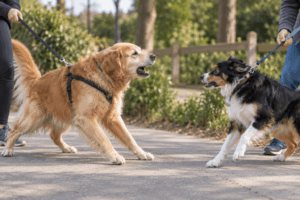
Restraint can change a dog’s behavioral response by limiting their ability to approach, retreat, or create distance. Some dogs show reactivity primarily while leashed, but that does not mean they are automatically safe around the same trigger when the leash is removed. Removing a leash or other safety barrier should not be used as a test of whether a dog is aggressive.
Barrier Frustration on Leash
Barrier frustration can occur when a leash, fence, or other restraint prevents a dog from approaching, retreating, or otherwise responding freely to a trigger. A dog may bark, lunge, pull, or whine when access or movement is restricted.
These behaviors may be strongly influenced by frustration, but frustration can coexist with fear, threat displays, or aggressive behavior, so appearance alone is not enough to determine the underlying motivation.
Some dogs show much less reactivity when they are not physically restrained. However, this should not be tested by simply releasing a reactive dog around a trigger. Safe evaluation requires an appropriately controlled environment.
Trigger-Specific Reactions
Common triggers for leash reactivity or leash-based aggressive behavior include other dogs, unfamiliar people, joggers, cyclists, children, and wildlife. In the Fort Myers area, busy sidewalks, neighborhood routes, parks, and beach-area access points can also create situations where dogs encounter triggers at relatively close distances.
Identifying triggers and thresholds is crucial in managing leash reactivity. Some dogs react at a considerable distance, while others respond only when a trigger comes much closer.
The difference between fear-based and frustration-related reactivity also matters. A dog that reacts fearfully to skateboards may require a different training setup from a puppy that becomes highly aroused because they want to greet people. Previous negative experiences can also contribute to persistent fear-based reactions.
Escalation Patterns
Escalation does not always follow a predictable sequence. Dogs may show lower-intensity signals such as looking away, lip licking, freezing, stiffening, or growling before progressing to barking, lunging, snapping, or biting, but individuals vary, and some signals may be brief or absent.
Punishing warning signals can suppress communication without resolving the underlying fear, frustration, or conflict.
Recent research examining reactive dogs has also shown that reactivity is not one uniform behavior pattern. Dogs can display different combinations of barking, lunging, posturing, snapping, or biting, which is why barking or lunging alone should not automatically be treated as evidence of a high bite risk. The American Animal Hospital Association also discusses this research and the differing risk profiles seen among reactive dogs.
Warning signs that your dog’s reactivity may require more careful assessment include faster or more intense escalation, snapping or biting attempts, difficulty recovering after the trigger passes, redirected aggression, or aggressive behavior beginning to appear in additional contexts—such as at home, around resources, or with particular people or animals.
Training Approaches and Management Strategies
Understanding your dog’s behavior pattern helps determine an appropriate training and management plan. Applying an unsuitable approach to a fearful or frustrated dog or treating serious aggressive behavior as simple leash frustration can create common mistakes that make the problem worse.
Counter-Conditioning Protocol
Counter-conditioning and desensitization are established behavior-modification techniques. Counter-conditioning aims to change a dog’s emotional response to a trigger by repeatedly pairing that trigger with something positive at an intensity or distance the dog can handle. It is commonly used alongside desensitization and other reinforcement-based strategies for fear- and anxiety-related behavior problems.
Here’s the systematic process:
- Identify trigger threshold distance — Find the distance at which your dog notices the trigger but remains calm enough to take a treat and respond to cues. This is your starting point.
- Reward calm behavior at a safe distance — Every time the trigger appears at or beyond threshold distance, provide a high-value reward.
- Gradually decrease distance — Over multiple sessions, slowly reduce the gap between your dog and the trigger while maintaining calm behavior. If barking or lunging returns, increase distance again.
- Practice in controlled Fort Myers locations — Start in quieter neighborhoods or lower-distraction environments before progressing to busier areas.
Useful leash-training strategies can also include teaching alternative behaviors such as looking toward the handler, turning away from a trigger, or performing another well-practiced cue while the dog is still able to learn.
Reward-based behavior modification is commonly recommended for fear- and anxiety-related behavior problems. The AVSAB Humane Dog Training Position Statement recommends reward-based training and notes welfare and behavior risks associated with aversive approaches.
Desensitization involves controlled exposure to a trigger at a level that does not overwhelm the dog. When paired with counter-conditioning, the goal is to build more positive or neutral associations while helping the dog remain able to respond and learn. Merck’s behavior-modification guidance explains how trigger intensity can be reduced by increasing distance or otherwise modifying the environment before gradually increasing exposure.
Management vs Training Comparison
| Criterion | Management | Training |
| Time investment | Ongoing planning and daily use as needed | Repeated practice over time; duration varies by dog |
| Equipment needed | Secure leash and well-fitted equipment; additional safety tools when appropriate | Rewards, secure handling equipment, and tools appropriate to the individual training plan |
| Professional help | Recommended when there is a bite history, severe aggression, or significant safety concern | Often beneficial and especially important for complex aggression cases |
| Long-term role | Reduces exposure and risk and may remain part of the long-term plan | Aims to teach alternative behaviors and improve the dog’s response to triggers; results vary |
| Best for | Immediate safety, preventing unwanted encounters, and supporting behavior modification | Skill building, controlled behavior modification, and improving coping and handler communication |
Management strategies for leash reactivity include increasing distance from triggers, choosing walking routes and times that reduce difficult encounters, and using secure, appropriately fitted equipment.
Management is an active part of behavior care, not merely a holding pattern. It can reduce risk, prevent repeated over-threshold reactions, and create better conditions for training. Some dogs may continue to need management even after substantial improvement. Veterinary behavior guidance also recognizes that some aggression triggers may require ongoing avoidance or management for safety.
Training and behavior modification can address specific skills, emotional responses, and behavior patterns while working alongside appropriate management. For Fort Myers dog owners dealing with significant aggression or reactivity, the local dog behavior training and behavior modification services provide information about available professional support. The site also lists a structured Behavior Modification Board & Train program for qualifying aggression cases.
Aggression does not have a guaranteed quick fix, and complete elimination of aggressive behavior cannot be promised. Results vary depending on the dog, behavior history, triggers, training consistency, and ongoing management.
Common Challenges and Solutions
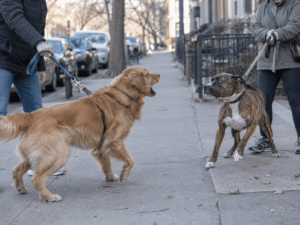
Even with the right approach, Southwest Florida dog owners may face obstacles that can stall progress or create setbacks.
Inconsistent Family Training
Reactivity training can stall when people in the household follow conflicting training or management approaches. If one family member maintains appropriate distance from triggers while another repeatedly allows close encounters, the dog may receive inconsistent experiences.
Everyone who handles the dog should understand the same safety plan, cues, trigger-management strategy, and training goals. Consistency helps reduce accidental setbacks without placing blame on individual family members.
Environmental Distractions
Southwest Florida can present practical training challenges, including warm weather, humidity, wildlife, seasonal crowds, and busy public environments.
Training during cooler periods when appropriate, selecting lower-distraction routes for early-stage work, and gradually increasing environmental complexity can make sessions easier to manage. The goal is to avoid overwhelming your dog while carefully expanding the situations they can handle.
Plateau in Progress
When progress stalls—or when reactivity becomes more intense—it may be time for professional evaluation.
Sudden behavior changes, signs of pain, or suspected medical or sensory problems should also be discussed with a veterinarian because physical conditions can contribute to irritability or aggression. The Merck Veterinary Manual notes that pain and other medical conditions can contribute to or worsen aggressive behavior.
For severe reactivity, a bite history, or significant safety concerns, a qualified behavior professional or board-certified veterinary behaviorist can help develop an appropriate risk-management and behavior plan.
Off Leash K9 Training’s behavior modification services provide structured training options for aggression and reactivity cases. The Behavior Modification Board & Train program includes evaluation and additional safety requirements for qualifying dogs.
Conclusion and Next Steps
The difference between leash reactivity and dog aggression isn’t merely academic—it affects decisions about training, equipment, management, and safety.
Reactivity describes a heightened response pattern, while aggression describes threatening behavior or the use of force. The two can overlap, and both may involve fear, frustration, anxiety, or other contributing factors. The safest plan depends on the complete behavior pattern, context, history, and level of risk.
Here are your immediate next steps:
- Document your dog’s behavior — Note the triggers, distance, body language, recovery time, context, and any history of snapping, biting, or redirected behavior.
- Implement appropriate management — Use secure, properly fitted equipment, increase distance from known triggers, and choose walking routes that reduce unnecessary close encounters. Do not use off-leash exposure as a test of your dog’s behavior.
- Seek professional help when needed — If your dog has a bite history, shows escalating aggression, or stops making progress, consult an appropriate behavior professional. Sudden behavioral changes or suspected pain should also be discussed with your veterinarian.
If you’re dealing with persistent leash reactivity or aggressive behavior in Fort Myers or the surrounding Southwest Florida area, consider discussing your dog’s history, triggers, and safety needs with a professional before choosing a program. You can review the full range of Fort Myers dog training services to compare available training options.
Off Leash K9 Training’s behavior modification programs are designed for dogs dealing with aggression, reactivity, severe anxiety, or related behavior concerns. The site also lists a Behavior Modification Board & Train option for qualifying cases. You can contact Off Leash K9 Training Ft. Myers to discuss your dog’s needs, ask questions about available training options, and determine appropriate next steps.
Frequently Asked Questions
What is the difference between leash reactivity and aggression?
Leash reactivity describes a heightened response to triggers while a dog is restrained, such as barking, lunging, pulling, or whining. Aggression involves threatening behavior or the use of force, including growling, snapping, or biting. The two can overlap, so behavior should be evaluated based on context, history, triggers, and overall risk.
Can a leash-reactive dog also be aggressive?
Yes. Leash reactivity and aggression are not mutually exclusive. A dog may react because of fear, frustration, excitement, or another trigger and may also display aggressive behavior such as snapping or biting. Barking or lunging alone does not determine aggression risk, which is why the dog’s complete behavior history and context matter.
Why is my dog reactive only when on a leash?
A leash limits a dog’s ability to approach, retreat, or create distance from a trigger. Some dogs become frustrated or fearful when restrained and may bark, pull, lunge, or stiffen. Although some dogs react less when not restrained, removing the leash should not be used as a test to determine whether a reactive dog is safe around a trigger.
Can leash reactivity get worse over time?
Leash reactivity can become more intense when a dog repeatedly encounters triggers at a level they cannot comfortably handle. Warning signs include stronger reactions, difficulty recovering after a trigger passes, snapping, biting attempts, or redirected aggression. Early management and appropriate training can help reduce repeated over-threshold encounters.
How can I help a dog with leash reactivity?
Start by identifying your dog’s triggers and maintaining enough distance for them to remain responsive. Management, desensitization and counter-conditioning, and teaching alternative behaviors may all be useful depending on the dog. Dogs with severe reactions, a bite history, or escalating aggression should be evaluated by an appropriate professional.
Does Off Leash K9 Training in Fort Myers work with reactive or aggressive dogs?
Yes. Off Leash K9 Training Ft. Myers lists behavior modification services for dogs dealing with aggression, reactivity, severe anxiety, timidness, and related behavior concerns. The site also offers a Behavior Modification Board & Train program for qualifying cases. Training needs and results vary by dog, and complete elimination of aggression cannot be guaranteed. Contact the Fort Myers team to discuss your dog’s behavior and available options.
