
Introduction
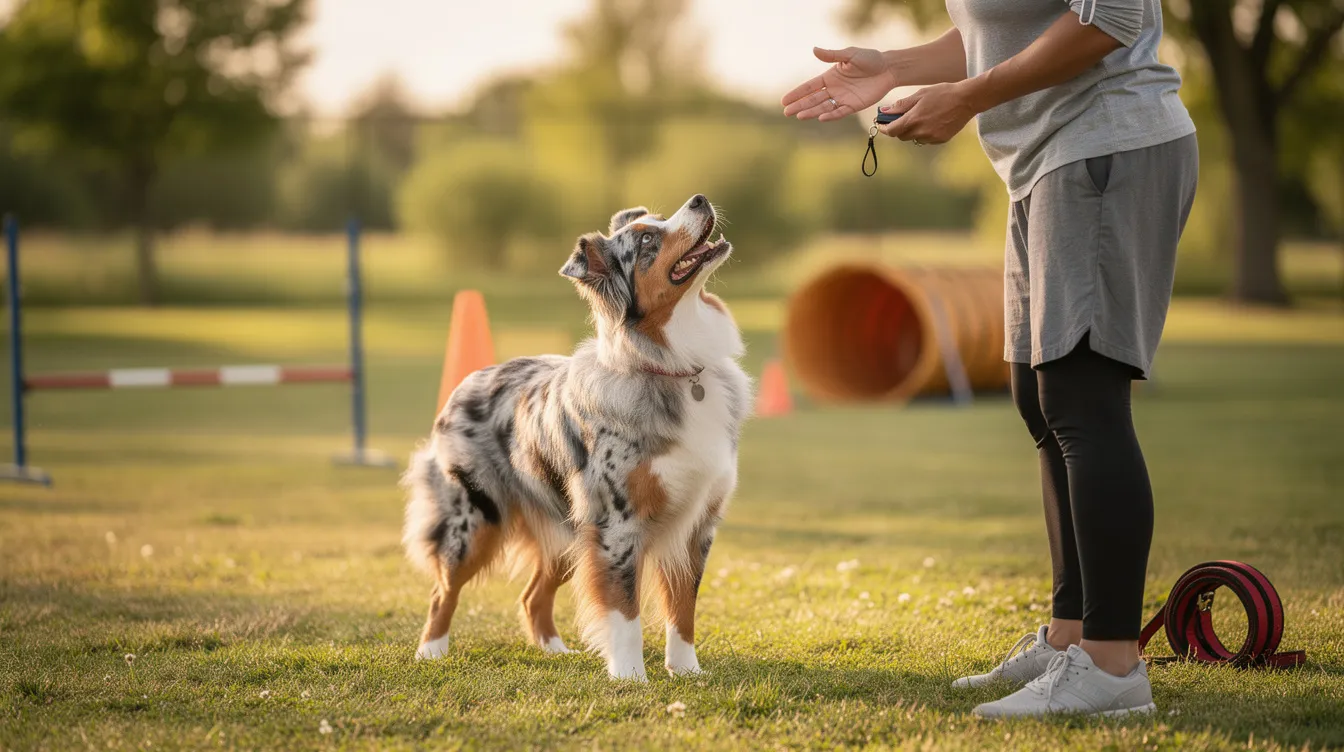
Australian Shepherds are energetic and intelligent working dogs that demand a training approach fundamentally different from what works with most other breeds. This complete Australian Shepherd training guide covers everything from bringing home a new Aussie puppy through advanced off-leash obedience, behavior modification for the adult dog, and the specialized challenges that come with owning one of the smartest herding dogs on the planet.
This guide is written for Australian Shepherd owners in Southwest Florida and beyond who want more than basic sit-stay compliance. If you’re tired of your Aussie ignoring you at the dog park, herding your children, or dragging you down the sidewalk, the training methods and protocols here will give you a clear path forward. Whether you just brought home a new dog or you’re working with a mature Aussie that has developed frustrating habits, the principles apply across different ages and experience levels.
Here’s the direct answer: to train an Australian Shepherd effectively, you need structured, consistent training that channels their working drive, closes behavioral loopholes their sharp minds will find, and builds distraction-proof reliability through progressive real-world exposure. Treat-heavy methods alone won’t cut it with this breed.
By the end of this guide, you’ll understand how to achieve:
- Reliable recall even around other dogs, wildlife, and high-distraction environments
- Controlled herding instincts so nipping, chasing, and circling stop being daily problems
- Calm, confident behavior in public settings, around strangers, and with family members
- Off-leash obedience that holds up in real life, not just in the living room
- Long-term behavior problem resolution for issues like barking, reactivity, and jumping
Understanding Australian Shepherd Training Fundamentals
What makes Australian Shepherd training fundamentally different from training a Labrador, Golden Retriever, or even a border collie comes down to three intertwined traits: exceptional intelligence, a powerful herding instinct, and a working drive that never truly shuts off. Understanding these traits isn’t optional background reading-it’s the foundation that every training session must be built on.
Australian Shepherds thrive when given structured tasks and clear communication. Without that structure, they create their own jobs, and those self-assigned roles rarely align with what dog owners actually want.
Working Breed Mentality and Intelligence
Australian Shepherds were developed in the western United States to herd livestock across vast, challenging terrain. They were selectively bred for independent decision-making, rapid problem-solving, and the ability to read situations without constant handler direction. That history means your Aussie isn’t just smart in the way that makes trick training easy-they’re smart in the way that makes them test every rule you set.
This intelligence manifests as a dog’s ability to find loopholes. If you enforce “no jumping” when you’re standing but not when you’re sitting, your Aussie notices. If recall works when you have food but not when you don’t, they learn that distinction immediately. Training should focus on closing loopholes in commands so that obedience is unconditional, not situational. Many Aussies develop what looks like “selective hearing,” but it’s actually a calculated assessment of whether the command is worth following in the current context. Australian Shepherds often exhibit selective hearing when distracted, and this is one of the most common frustrations Aussie owners face.
Herding Instincts and Drive Management
The herding instinct in Australian Shepherds includes specific, genetically wired behaviors: heel-nipping, circling, stalking, eyeing movement, and attempting to control anything that moves. This isn’t aggression-it’s the same behavioral sequence that made these dogs invaluable on ranches. Aussies have strong herding and guardian instincts that show up whether they live on a farm or in a suburban neighborhood.
The distinction between herding drive and prey drive matters for training. Herding drive follows a pattern of eye, stalk, gather, nibble, and control-focused on managing movement rather than a chase-and-kill sequence. When your pup circles your kids or nips at joggers, they’re trying to herd, not hunt. Redirecting herding instincts can prevent destructive behaviors in Australian Shepherds, but the redirection must offer a meaningful outlet. Sports like treibball, agility, and structured fetch games give herding dogs an appropriate channel for these instincts.
Early socialization reduces the risk of nipping and herding behaviors. Australian Shepherds can learn to control herding instincts with training, but only when that training starts early and remains consistent.
Energy and Mental Stimulation Requirements
Here’s something that surprises many new Aussie owners: running for miles usually won’t tire out an Australian Shepherd. They can bounce back quickly from physical exercise, which is exactly what they were bred to do. This active breed needs approximately 1–2 hours of physical exercise daily, but that alone won’t produce a calm, well-behaved dog.
Mental stimulation is the missing piece for most dog owners struggling with this breed. Mental exercise is crucial for a calm and well-behaved Aussie. Daily exercise for Australian Shepherds should include both physical activity and mental challenges-puzzle feeders, stuffed kongs, scent work, obedience drills, and trick training all count as mental exercise. Australian Shepherds require a varied daily routine to engage their minds and bodies, and when these needs go unmet, you see the predictable fallout: destructive behavior, excessive barking, anxiety, and an inability to settle.
A well-trained Australian Shepherd is mentally fulfilled and responsive to commands-and fulfillment comes from both physical exercise and structured mental work. This is precisely why traditional training methods that focus only on basic commands in controlled settings tend to fail with this breed.
Proven Training Methods for Australian Shepherds
Because Aussies are wired differently than most companion breeds, the training methods that work for them must account for their intelligence, drive, and need for clear boundaries. Understanding how breed matters in training is the first step toward choosing the right approach.
Structured vs. Treat-Based Training Systems
Positive reinforcement is effective for training Australian Shepherds-there’s no debate about that. Positive reinforcement encourages learning and builds trust with Australian Shepherds. But there’s a critical difference between using positive reinforcement as a principle and relying exclusively on treats as your only tool.
Pure treat-based training often fails with Australian Shepherds because these energetic dogs quickly learn the pattern: treats present means comply, treats absent means optional. A structured training system goes beyond the small treat in your hand. It incorporates consistent cues, rules, and clear boundaries that apply everywhere-in the house, the yard, on walks, at the beach-not just during formal training sessions. Positive reinforcement helps establish a strong bond with your dog while structured expectations ensure that bond translates into reliable behavior.
As behaviors become reliable, rewards should be faded to intermittent schedules or substituted with life rewards like play, freedom, and access to exciting environments. Variable-ratio reinforcement schedules produce the strongest, most persistent behavior-similar to how a slot machine keeps people pulling the lever. This approach builds resistance to extinction, meaning behaviors hold up even when the reward isn’t guaranteed every time.
Off-Leash Obedience Training Principles
Off-leash obedience isn’t a party trick-it’s the natural expression of truly reliable dog training. For Australian Shepherds, whose intelligence and independence mean they’re constantly evaluating whether to listen, distraction-proof reliability must be built systematically.
The foundation starts on-leash in low-distraction environments. From there, you progress to long lines (15–30 feet), then to off-leash work in controlled settings like fenced yards, and finally to real-world environments. Each stage requires the dog to demonstrate consistent compliance before advancing. The standard benchmark: 90% or higher recall reliability at the current level before moving to the next.
This approach addresses the breed’s intelligence and independence head-on. Rather than hoping your Aussie listens when it matters, you build verified reliability layer by layer.
Consistency and Leadership Establishment
Australian Shepherds are not a breed that tolerates ambiguity. Puppies need clear leadership from a young age-not dominance or intimidation, but consistent rules that every family member enforces identically. Control food and toys to establish leadership. Use a leash to reinforce your leadership role, even indoors during the early stages.
If one person in the household allows jumping while another punishes it, or if “come” sometimes means now and sometimes means whenever you feel like it, an Aussie will exploit that inconsistency every time. All this training falls apart without household-wide agreement on rules and expectations.
Step-by-Step Australian Shepherd Training Implementation
With the principles established, here’s the practical framework for moving from an unruly Australian Shepherd puppy to a dog with off-leash reliability.
Foundation Training Protocol
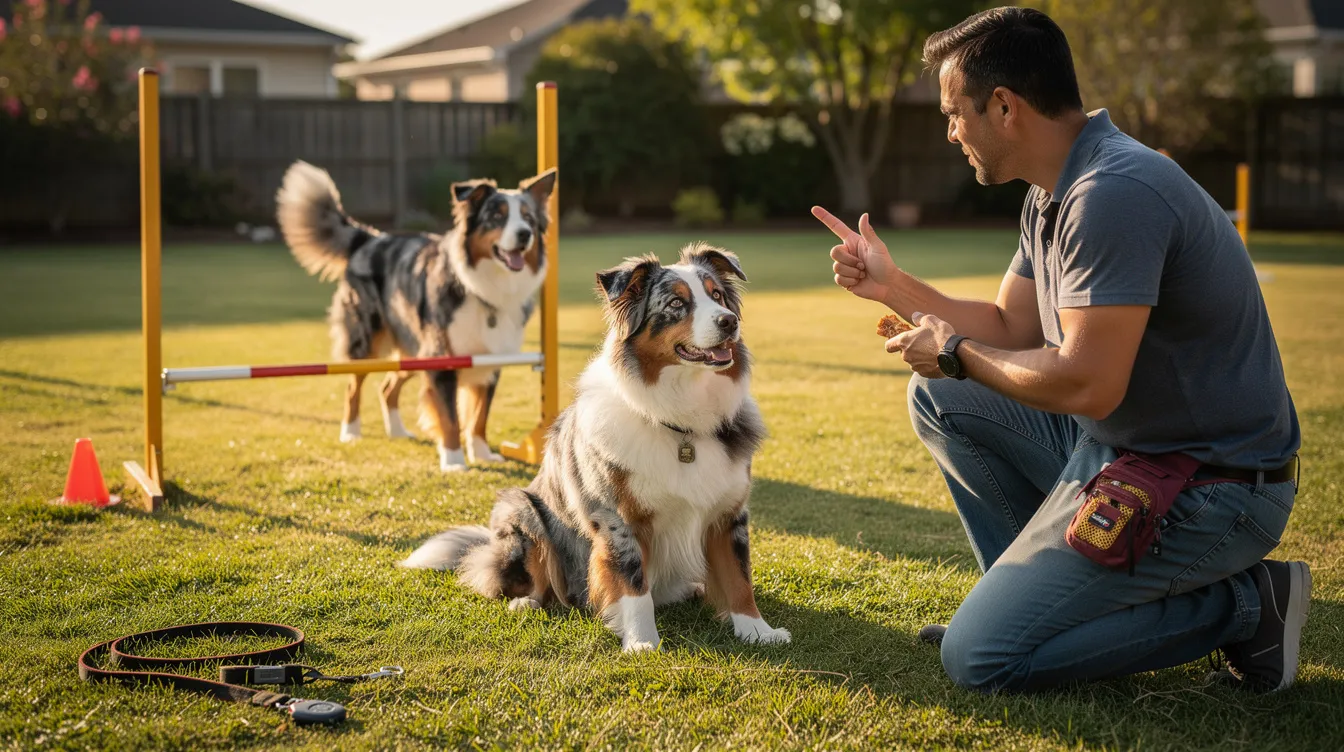
Training should start immediately when bringing home an Australian Shepherd puppy. Don’t wait for the first week to pass or for your pup to “settle in.” The habits you allow on day one become the habits you’ll fight to break later. Here’s the essential foundation protocol:
- Socialization and early exposure (8–16 weeks): Australian Shepherds need three times the socialization of retrievers. This isn’t an exaggeration-it’s critical for preventing fearfulness and reactivity. Socialization helps prevent anxiety and aggressive behaviors in Aussies. Expose young puppies to varied environments, people of all ages, other dogs, other animals including cats, novel surfaces, and movement triggers. Adult Australian Shepherds often ignore strangers and are reserved, which makes early exposure to new person encounters essential. Proper socialization can lead to a well-adjusted adult Australian Shepherd, while insufficient socialization creates lifelong reactivity problems. Aussies should be socialized with various people and environments.
- Basic commands and attention training: Teach sit, down, stand, and come with short, focused sessions. Training sessions for Australian Shepherds should be short to prevent mental fatigue. Use clicker training or marker signals for precise timing. Teach “look at me” attention cues early-body language and facial expressions from your dog will tell you when focus is drifting.
- Impulse control exercises: “Wait at the door,” “leave it,” sit stay, and delayed feeding all teach delayed gratification. Impulse control commands help manage Australian Shepherds’ strong instinctual behaviors. These exercises buffer the instinctive impulses that make Aussies chase, nip, and react before thinking.
- House training and crate training: Crate training helps prevent accidents in the house. Puppies can hold their bladder for hours equal to their age in months. Take your puppy out after every nap and meal, and praise your puppy every time he goes outside to potty. Use a leash indoors to monitor your puppy’s potty cues. Start training to crate train early-it provides structure, safety, and a foundation for calm settling behavior.
- Distraction introduction and reliability testing: Gradually increase exposure to household movement, neighborhood sounds, playing fetch near other things that compete for attention, and eventually outdoor environments. Test response under various conditions-distance, duration, distractions-using long lines for safety.
Training Method Comparison
| Criteria | Traditional Leash/Indoor Training | Off-Leash Real-World Obedience |
|---|---|---|
| Effectiveness with distractions | Low to moderate; breaks down around bikes, wildlife, other dogs | High; specifically built for real-world stimuli |
| Time to initial results | Faster for simple commands in controlled settings | Slower start, but more durable and transferable |
| Long-term reliability | Poor without constant reinforcement or supervision | Strong; behaviors resist extinction through varied training |
| Suitability for Aussie intelligence | Addresses basic obedience but leaves loopholes for smart dogs | Matches the breed’s need for challenge and mental engagement |
| Herding drive management | Limited tools for redirecting instincts | Incorporates drive channeling into training progression |
For Australian Shepherds, the clear recommendation is an off-leash, real-world approach. Traditional methods may produce a dog that performs in obedience classes but falls apart the moment an interesting smell or a squirrel appears. Aussies love a challenge, and off-leash training provides exactly that.
Advanced Training Progression
Once basic obedience is reliable at home and in the yard, it’s time to transition to advanced training:
- Add distance work-giving commands from 20, 30, then 50 feet away
- Introduce blind cues where the dog responds when outside your line of sight
- Layer in hand signals alongside verbal commands
- Train the emergency stop-a potentially life-saving command in Southwest Florida, where wildlife like alligators and snakes present real danger
- Incorporate dog agility training or herding activities to give your Aussie meaningful “jobs”
Australian Shepherds require consistent mental and physical stimulation for training success. Ongoing training isn’t something you complete and check off-it’s a lifestyle commitment with a breed that has more energy and intelligence than most dog owners expect.
Common Australian Shepherd Training Challenges and Solutions
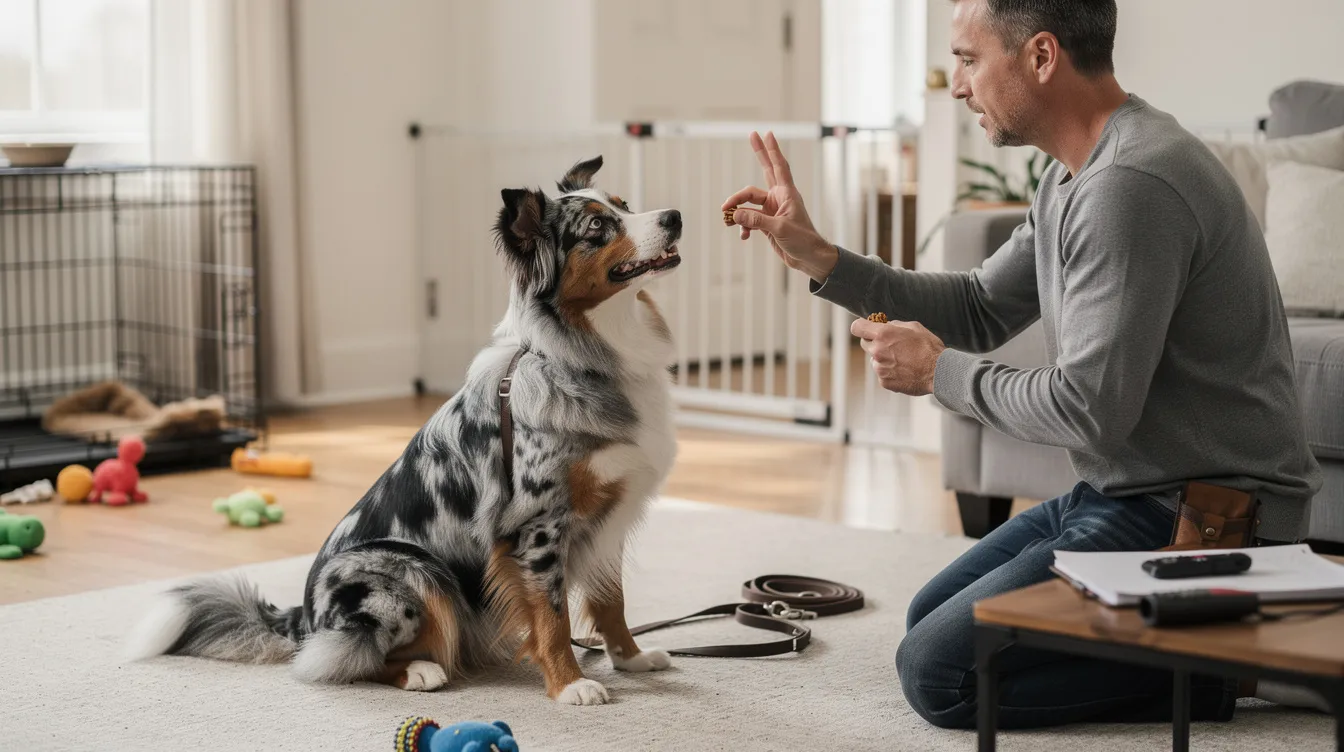
Every herding breed comes with predictable challenges. Knowing what to expect-and having solutions ready-prevents frustration and keeps training on track.
Selective Hearing and Distraction Issues
Your Aussie sits perfectly in the kitchen but acts deaf at the park. This isn’t defiance-it’s a training gap. The behavior was never proofed under distraction, so the dog legitimately doesn’t understand that “come” applies everywhere.
Solution: Make the recall cue sacred-never pair it with a negative outcome. Use long lines to enforce compliance during training rather than repeating commands. Build check-in habits where the dog voluntarily looks at you in distracting environments, rewarding those moments heavily. Graduate through increasing levels of distraction only after achieving consistent success at the current level. Treats are useful early, but phase in life rewards-access to play, freedom, the walk continuing-so the owner isn’t dependent on having food available.
Herding and Chasing Behaviors
Nipping at heels, chasing runners, circling visitors, trying to “gather” kids or cats-these are hardwired herding behaviors, not bad manners. Punishing the instinct creates anxiety without solving the problem.
Solution: Teach “leave it” and “off” early and enforce consistently. Learn to recognize “lock-on” behaviors-the crouch, intense eye contact, and stalking posture-and interrupt before escalation. Channel the drive through structured activities: treibball, playing fetch with rules, and agility courses. Many Aussies calm substantially when given appropriate outlets for their herding instinct. For families with children, supervised interactions with clear rules are non-negotiable during the early months.
Jumping and Overly Enthusiastic Greetings
Aussies are enthusiastic greeters, and jumping is one of the most common complaints from owners. Here’s a critical point: ignoring jumping behavior often makes it worse for Australian Shepherds. Simply turning away may not be enough for a dog with this much persistence and energy.
Solution: Rather than just ignoring, actively require an incompatible behavior. The dog must have all four paws on the floor or be in a sit before any greeting occurs. Every person in the family must enforce this identically. Create a structured arrival routine: door opens, dog goes to place or sits, calm greeting happens. Consistency across all humans-guests included-is what makes this work. Don’t rely solely on treat-based methods; the structure itself becomes the reward when greeting is the life reward.
Barking and Reactivity on Walks
Barking at passers-by, lunging at other dogs, and reactive vocalizations make walks stressful for everyone. This often stems from insufficient socialization, under-stimulation, or both.
Solution: Begin desensitization and counter-conditioning from a safe distance. Reward calm behavior when strangers, Aussies from neighboring yards, or other animals pass by. Gradually decrease distance as the dog succeeds. Teach a “quiet” or “enough” cue paired with rewarding silence. At home, increase mental stimulation-stuffed Kongs, puzzle feeders, scent work-to lower the baseline arousal that fuels reactivity. Remember how much exercise and mental work this breed actually needs; a dog running on excess energy will always be more reactive.
Leash Pulling and Zigzagging
A 50-pound Aussie with more energy than a marathon runner can make a walk miserable. They pull, zigzag after every interesting smell, and generally treat the leash as an obstacle rather than a partnership tool.
Solution: Use the stop-and-go method: forward progress only happens when the leash is slack. Change direction unpredictably when pulling occurs, making it more rewarding to pay attention to you than to forge ahead. Use a well-fitted harness for safety. Keep early walk routines highly structured with frequent directional changes and reward calm walking beside you. As impulse control improves through rest of the training program, leash manners typically improve in parallel.
Conclusion and Next Steps
Australian Shepherds are the best dog for owners who want a true partner-but only when that partnership is built on training that matches the breed’s intelligence, drive, and energy. The training advice in this guide works because it respects what Aussies are: brilliant, driven working dogs navigating a human world they weren’t designed for.
Here are your immediate action steps:
- Assess your current situation. Identify the specific behaviors causing problems-selective hearing, herding family members, reactivity-and prioritize the most urgent ones.
- Establish consistent household rules. Get every family member on the same page about clear boundaries, commands, and enforcement before starting any formal training.
- Start foundation training immediately. Whether you have an Aussie puppy or an older dog that needs training, the principles are the same-begin with attention, impulse control, and basic commands in low-distraction settings.
- Consider professional support. For owners who want accelerated results or who are dealing with serious behavior issues, professional programs designed for this breed can compress months of work into weeks.
If you’re interested in specialized approaches, explore topics like boot camp-style board-and-train programs, behavior modification for reactive Aussies, and therapy dog training for dogs that have the temperament for service work.
Professional Training Support
For Australian Shepherd owners in Fort Myers and throughout Southwest Florida, Off Leash K9 Training specializes in exactly the kind of structured, real-world obedience these energetic dogs require. We strongly recommend exploring professional support if you’re serious about off-leash reliability.
Our programs include board-and-train options that immerse your Aussie in intensive, structured training, private lessons tailored to your specific challenges, and behavior modification programs for dogs dealing with reactivity, aggression, or deep-seated behavioral issues. All of our training is designed to produce distraction-proof results that hold up on Southwest Florida beaches, in busy parks, and around the wildlife unique to our region.
Contact us for a free consultation to assess your Australian Shepherd’s individual training needs and determine the right path to off-leash obedience.
